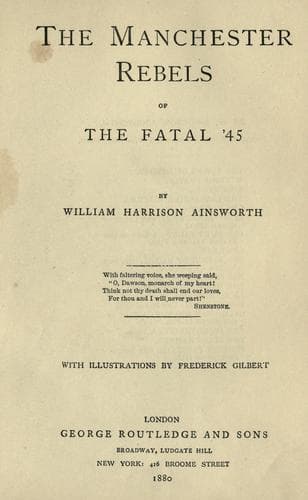
The Manchester Rebels of the Fatal '45Ainsworth, William Harrison
History
The Manchester Rebels of the Fatal '45
Ainsworth, William Harrison
Great Britain -- History -- George II, 1727-1760 -- Fiction; Jacobite Rebellion, 1745-1746 -- Fiction
"I know not what your opinion may be," he said; "but I think the grand
error committed by the prince was in avoiding an engagement. He ought
to have attacked the Duke of Cumberland at Lichfield. A battle would
have been decisive, and if the prince had been victorious his ultimate
success must have been assured. But the retreat without an engagement
was fatal to the cause. The Scottish chiefs, I know, refused to march
further than Derby, but if they had been forced to fight, their
conduct would have been totally different. Even if the prince had been
worsted--had he fallen--he would have left a glorious name behind him!
Had my own brave sons died sword in hand, I should have been
reconciled to their loss, but to think that they have been compelled
to retreat ingloriously, without striking a blow, because their
leaders lost heart, enrages me, and sharpens my affliction. Then I
consider that the Manchester Regiment has been wantonly sacrificed. It
ought never to have been left at Carlisle. That the prince thought the
place tenable, and meant to reinforce the scanty garrison, I nothing
doubt--but he lacked the means. Surrender was therefore unavoidable. I
shall always think that the regiment has been sacrificed--but I blame
Colonel Townley, and not the prince."
"Disastrous as the result has been, I must take up Colonel Townley's
defence," said Atherton. "He felt certain he could hold out till he
was relieved by the prince, and all the officers shared his
opinion--none being more confident than your gallant son Theodore."
"Alas!" exclaimed the doctor, bitterly. "Of what avail is bravery
against such engines of destruction as were brought to bear against
the town by the Duke of Cumberland. But could not a desperate sortie
have been made? Could you not have cut your way through the enemy?
Death would have been preferable to such terms of surrender as were
exacted by the duke."
"Such an attempt as you describe was made, sir," replied Atherton,
"but it failed; I, myself, was engaged in it, and was captured."
"True, I now remember. Forgive me. Grief has made me oblivious. But I
must not allow my own private sorrows to engross me to the neglect of
others. Can I assist you in any way?"
Atherton then informed him of his design to proceed to London, and the
doctor approved of the plan, though he thought the journey would be
attended by considerable risk.
"Still, if you get to London you will be comparatively secure, and may
perhaps be able to negotiate a pardon. Dr. Byrom has promised to come
over to me to-day, and may perhaps bring his daughter with him. He has
considerable influence with several persons of importance in London,
and may be able to serve you. We shall hear what he says."
"But why think of me?" cried Atherton. "Why do you not urge him to use
his influence in behalf of your sons?"
Public-domain text, read in full here on John Shaqi.
Reviews
Reviews
No reviews yet
Be the first to share your thoughts on this work.
Elsewhere in the archive
Join the Discussion
Join the discussion
Sign in to leave a comment or review.
Sign InorCreate an account