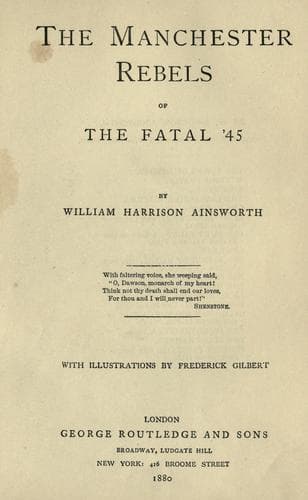
The Manchester Rebels of the Fatal '45Ainsworth, William Harrison
History
The Manchester Rebels of the Fatal '45
Ainsworth, William Harrison
Great Britain -- History -- George II, 1727-1760 -- Fiction; Jacobite Rebellion, 1745-1746 -- Fiction
"I will act for the best," observed Markland. "Nothing shall go wrong
if I can help it. But you must please excuse me, miss. I have much to
do, and not too much time to do it in. I must get the old coach put in
order for the journey. As you know, it has not been out for this many
a day."
"Daughter," said the priest, as soon as Markland was gone, "you place
too much confidence in that man. I hope you may not be deceived in
him. He ought not to have access to the strong room. Better leave the
key of that room with me."
"I would not hurt his feelings by withholding that key from him,"
replied Constance. "But I have no fear of Markland. He is honesty
itself."
Later on in the day, Constance had some further conversation in
private with the old butler, and, notwithstanding Father Jerome's
disparaging observations, she showed no diminution in her confidence
in him; but gave him particular instructions as to how he was to act
under certain circumstances, and concluded by desiring him on no
account to allow the priest to enter the strong room.
"He has no business there, Markland," she observed, significantly.
"And I will take good care he doesn't get in," rejoined the old
butler. "I think I shall prove a match for Father Jerome, with all his
cunning. But oh! my dear young lady," he added, "how it would gladden
my heart if you should be able to bring back Sir Conway with you. Oh!
if I should see him restored to his own, and made happy with her he
loves best, I shall die content!"
"Well, Markland, Dr. Byrom holds out a hope of pardon. Should I have
any good news to communicate, you shall be among the first to hear
it."
"Thank you! thank you, miss!" he cried, hastening out of the room to
hide his emotion.
The parting between Monica and her mother took place in the invalid
lady's room. No one was present at the time, for Constance had just
bade adieu to her aunt. As Monica knelt on a footstool beside her
mother, the latter gazed long and earnestly into her face, as if
regarding her for the last time.
"We shall never meet again in this world, my dear child," she said. "I
shall be gone before you return. But do not heed me. You cannot
disobey the summons you have received. Go!--attend your affianced
husband in his prison. Lighten his captivity. Solace him--pray with
him--and should his judges condemn him, prepare him to meet his fate!"
"I will--I will," cried Monica. "But do not utterly dishearten me."
"I would not pain you, my dear child," said her mother, in accents of
deepest sympathy. "But the words rise unbidden to my lips, and I must
give utterance to them. Your case has been my case. Agony, such as I
once endured, you will have to endure. But your trial will not be
prolonged like mine. I had a terrible dream last night. I cannot
recount it to you, but it has left a profound impression on my mind. I
fear what I beheld may come to pass."
"What was it?" exclaimed Monica, shuddering. "Let me know the worst. I
can bear it."
Public-domain text, read in full here on John Shaqi.
Reviews
Reviews
No reviews yet
Be the first to share your thoughts on this work.
Elsewhere in the archive
Join the Discussion
Join the discussion
Sign in to leave a comment or review.
Sign InorCreate an account