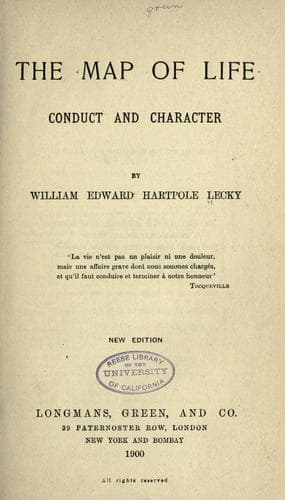
The Map of Life: Conduct and CharacterLecky, William Edward Hartpole
Philosophy
The Map of Life: Conduct and Character
Lecky, William Edward Hartpole
Character; Conduct of life
Another class of politicians approach the question from a wholly
different point of view. They emphatically object to imposing upon
grown-up men a system of moral restriction which is very properly
imposed upon children. They contend that adult men who have assumed all
the duties and responsibilities of life, and have even a voice in the
government of the country, should regulate their own conduct, as far as
they do not directly interfere with their neighbours, without legal
restraint, bearing themselves the consequences of their mistakes or
excesses. This, they say, is the first principle of freedom, the first
condition in the formation of strong and manly characters. A poor man,
who desires on his Sunday excursion to obtain moderate refreshment such
as he likes for himself or his family, and who goes to the
public-house--probably in most cases to meet his friends and discuss the
village gossip over a glass of beer--is in no degree interfering with
the liberty of his neighbours. He is doing nothing that is wrong;
nothing that he has not a perfect right to do. No one denies the rich
man access to his club on Sunday, and it should be remembered that the
poor man has neither the private cellars nor the comfortable and roomy
homes of the rich, and has infinitely fewer opportunities of recreation.
Because some men abuse this right and are unable to drink alcohol in
moderation, are all men to be prevented from drinking it at all, or at
least from drinking it on Sunday? Because two men agree not to drink it,
have they a right to impose the same obligation on an unwilling third?
Have those who never enter a public-house, and by their position in life
never need to enter it, a right, if they are in a majority, to close
its doors against those who use it? On such grounds these politicians
look with extreme disfavour on all this restrictive legislation as
unjust, partial and inconsistent with freedom.
Public-domain text, read in full here on John Shaqi.
Reviews
Reviews
No reviews yet
Be the first to share your thoughts on this work.
Elsewhere in the archive
Join the Discussion
Join the discussion
Sign in to leave a comment or review.
Sign InorCreate an account