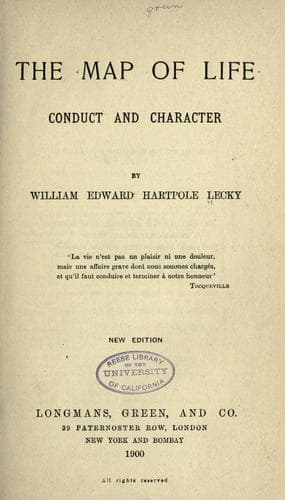
The Map of Life: Conduct and CharacterLecky, William Edward Hartpole
Philosophy
The Map of Life: Conduct and Character
Lecky, William Edward Hartpole
Character; Conduct of life
The temptations of party politicians are of many kinds and vary greatly
with different stages of political development. The worst is the
temptation to war. War undertaken without necessity, or at least without
serious justification, is, according to all sound ethics, the gravest of
crimes, and among its causes motives of the kind I have indicated may be
often detected. Many wars have been begun or have been prolonged in
order to consolidate a dynasty or a party; in order to give it
popularity or at least to save it from unpopularity; in order to divert
the minds of men from internal questions which had become dangerous or
embarrassing, or to efface the memory of past quarrels, mistakes or
crimes.[43] Experience unfortunately shows only too clearly how easily
the combative passions of nations can be aroused and how much popularity
may be gained by a successful war. Even in this case, it is true, war
usually impoverishes the country that wages it, but there are large
classes to whom it is by no means a calamity. The high level of
agricultural prices; the brilliant careers opened to the military and
naval professions; the many special industries which are immediately
stimulated; the rise in the rate of interest; the opportunities of
wealth that spring from violent fluctuations on the Stock Exchange; even
the increased attractiveness of the newspapers,--all tend to give
particular classes an interest in its continuance. Sometimes it is
closely connected with party sympathies. During the French wars of Anne,
the facts that Marlborough was a Whig, and that the Elector of Hanover,
who was the hope of the Whig party, was in favour of the war,
contributed very materially to retard the peace. A state of great
internal disquietude is often a temptation to war, not because it leads
to it directly, but because rulers find a foreign war the best means of
turning dangerous and disturbing energies into new channels, and at the
same time of strengthening the military and authoritative elements in
the community. The successful transformation of the anarchy of the great
French Revolution into a career of conquest is a typical example.
In aristocratic governments such as existed in England during the
eighteenth century, temptations to corruption were especially strong. To
build up a vast system of parliamentary influence by rotten boroughs,
and, by systematically bestowing honours on those who could control
them, to win the support of great corporations and professions by
furthering their interests and abstaining from all efforts to reform
them, was a chief part of the statecraft of the time. Class privileges
in many forms were created, extended and maintained, and in some
countries--though much less in England than on the Continent--the burden
of taxation was most inequitably distributed, falling mainly on the
poor.
Public-domain text, read in full here on John Shaqi.
Reviews
Reviews
No reviews yet
Be the first to share your thoughts on this work.
Elsewhere in the archive
Join the Discussion
Join the discussion
Sign in to leave a comment or review.
Sign InorCreate an account