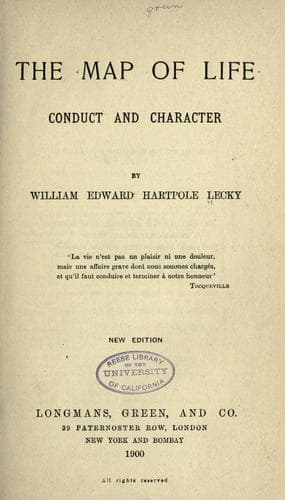
The Map of Life: Conduct and CharacterLecky, William Edward Hartpole
Philosophy
The Map of Life: Conduct and Character
Lecky, William Edward Hartpole
Character; Conduct of life
To those who judge the political ethics of the Roman Catholic Church not
from the deceptive pages of such writers as Newman, but from an
examination of its actual conduct in the different periods of its
history, it will appear in no degree inconsistent. It is but another
instance added to many of the manner in which it regards all acts which
appear conducive to its interests. It was the same spirit that led a
Pope to offer public thanks for the massacre of St. Bartholomew, and to
order Vasari to paint the murder of Coligny on the walls of the Vatican
among the triumphs of the Church. No Christian sovereign of modern times
has left a worse memory behind him than Ferdinand II. of Naples, who
received the Pope when he fled to Gaëta in 1848. He was the sovereign
whose government was described by Gladstone as 'a negation of God.' He
not only destroyed the Constitution he had sworn to observe, but threw
into a loathsome dungeon the Liberal ministers who had trusted him. But
in the eyes of the Pope his services to the Church far outweighed all
defects, and the monument erected to this 'most pious prince' may be
seen in one of the chapels of St. Peter's. Every visitor to Paris may
see the fresco in the Madeleine in which Napoleon I. appears seated
triumphant on the clouds and surrounded by an admiring priesthood, the
most prominent and glorified figure in a picture representing the
history of French Christianity, with Christ above, blessing the work.
It is indeed a most significant fact that in Catholic countries the
highest moral level in public life is now rarely to be found among those
who specially represent the spirit and teaching of their Church, and
much more frequently among men who are unconnected with it, and often
with all dogmatic theology. How seldom has the distinctively Catholic
press seriously censured unjust wars, unscrupulous alliances, violations
of constitutional obligations, unprovoked aggressions, great outbursts
of intolerance and fanaticism! It is, indeed, not too much to say that
some of the worst moral perversions of modern times have been supported
and stimulated by a great body of genuinely Catholic opinion both in the
priesthood and in the press. The anti-Semite movement, the shameful
indifference to justice shown in France in the Dreyfus case, and the
countless frauds, outrages and oppressions that accompanied the
domination of the Irish Land League are recent and conspicuous examples.
Public-domain text, read in full here on John Shaqi.
Reviews
Reviews
No reviews yet
Be the first to share your thoughts on this work.
Elsewhere in the archive
Join the Discussion
Join the discussion
Sign in to leave a comment or review.
Sign InorCreate an account