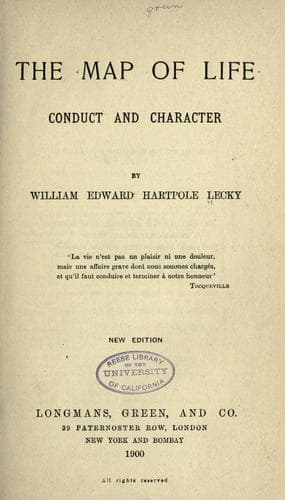
The Map of Life: Conduct and CharacterLecky, William Edward Hartpole
Philosophy
The Map of Life: Conduct and Character
Lecky, William Edward Hartpole
Character; Conduct of life
The question was indeed one of great difficulty. The Government, in my
opinion, were right in not attempting a prosecution which, in the face
of the fact that the actual raid had certainly been undertaken without
the knowledge of Mr. Rhodes, and that the evidence against him was
chiefly drawn from his own voluntary admissions before the committee of
inquiry, would inevitably have proved abortive. They were, perhaps,
right in not taking from him the dignity of Privy Councillor, which had
been bestowed on him as a reward for great services in the past, and
which had never in the present reign been taken from anyone on whom it
had been bestowed. They were right also, I believe, in urging that after
a long and elaborate inquiry into the circumstances of the raid, and
after a report in which Mr. Rhodes's conduct had been fully examined and
severely censured, it was most important for the peace and good
government of South Africa that the matter should as soon as possible be
allowed to drop, and the raid and the party animosities it had aroused
to subside. But what can be thought of the language of a Minister who
volunteered to assure the House of Commons that in all the transactions
I have described, Mr. Rhodes, though he had made 'a gigantic mistake,' a
mistake perhaps as great as a statesman could make, had done nothing
affecting his personal honour?[57]
The foregoing examples will serve to illustrate the kind of difficulty
which every statesman has to encounter in dealing with political
misdeeds, and the impossibility of treating them by the clearly defined
lines and standards that are applicable to the morals of a private life.
Whatever conclusions men may arrive at in the seclusion of their
studies, when they take part in active political life they will find it
necessary to make large allowances for motives, tendencies, past
services, pressing dangers, overwhelming expediencies, opposing
interests. Every statesman who is worthy of the name has a strong
predisposition to support the public servants who are under him when he
knows that they have acted with a sincere desire to benefit the Empire.
This is, indeed, a characteristic of all really great statesmen, and it
gives a confidence and energy to the public service which in times of
difficulty and danger are of supreme importance. In such times a
mistaken decision is usually a less evil than timid, vacillating, or
procrastinated action, and a wise Minister will go far to defend his
subordinates if they have acted promptly and with substantial justice in
the way they believed to be best, even though they may have made
considerable mistakes, and though the results of their action may have
proved unfortunate.
Public-domain text, read in full here on John Shaqi.
Reviews
Reviews
No reviews yet
Be the first to share your thoughts on this work.
Elsewhere in the archive
Join the Discussion
Join the discussion
Sign in to leave a comment or review.
Sign InorCreate an account