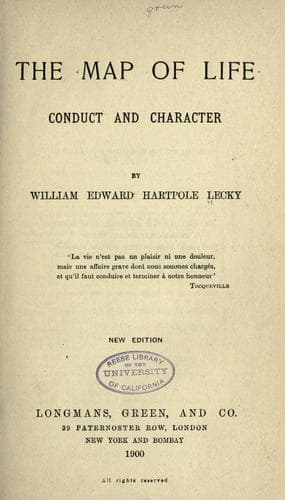
The Map of Life: Conduct and CharacterLecky, William Edward Hartpole
Philosophy
The Map of Life: Conduct and Character
Lecky, William Edward Hartpole
Character; Conduct of life
The questions of morality arising out of these things are many and
complicated, and they cannot be disposed of by short and simple formulæ.
How far is a statesman who sees, or thinks he sees, some crushing danger
from an aggressive foreign Power impending over his country, justified
in anticipating that danger, and at a convenient moment and without any
immediate provocation forcing on a war? How far is it his right or his
duty to sacrifice the lives of his people through humanitarian motives,
for the redress of some flagrant wrong with which he is under no treaty
obligation to interfere? How far, if several Powers agree to guarantee
the integrity of a small Power, is one Power bound at great risk to
interfere in isolation if its co-partners refuse to do so or are even
accomplices in a policy of plunder? How far, if the aggression of other
Powers places his nation at a commercial or other disadvantage in the
competition of nations, may a statesman take measures which, under
other circumstances, would be plainly unjustifiable, to guard against
such disadvantage? With what degrees of punctiliousness, at what cost of
treasure and of life, ought a nation to resent insults directed against
its dignity, its subjects and its flag? What is the meaning and what are
the limits of national egotism and national unselfishness? There is such
a thing as the comity of nations, and even apart from treaty obligations
no great nation can pursue a policy of complete isolation, disregarding
crimes and aggressions beyond its border. On the other hand, the primary
duty of every statesman is to his own country. His task is to secure for
many millions of the human race the highest possible amount of peace and
prosperity, and a selfishness is at least not a narrow one which, while
abstaining from injuring others, restricts itself to promoting the
happiness of a vast section of the human race. Sacrifices and dangers
which a good man would think it his clear duty to accept if they fell on
himself alone wear another aspect if he is acting as trustee for a great
nation and for the interests of generations who are yet unborn. Nothing
is more calamitous than the divorce of politics from morals, but in
practical politics public and private morals will never absolutely
correspond. The public opinion of the nation will inevitably inspire and
control its statesmen. It creates in all countries an ethical code which
with greater or less perfection marks out for them the path of duty, and
though a great statesman may do something to raise its level, he can
never wholly escape its influence. In different nations it is higher or
lower--in truthfulness and sincerity of diplomacy the variations are
very great--but it will never be the exact code on which men act in
private life. It is certainly widely different from the Sermon on the
Mount.
Public-domain text, read in full here on John Shaqi.
Reviews
Reviews
No reviews yet
Be the first to share your thoughts on this work.
Elsewhere in the archive
Join the Discussion
Join the discussion
Sign in to leave a comment or review.
Sign InorCreate an account