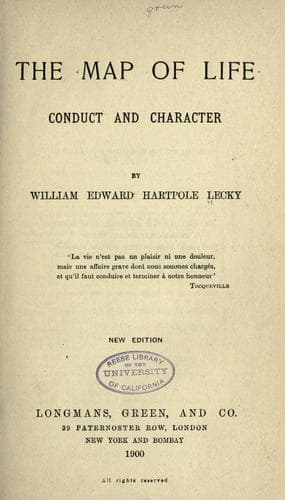
The Map of Life: Conduct and CharacterLecky, William Edward Hartpole
Philosophy
The Map of Life: Conduct and Character
Lecky, William Edward Hartpole
Character; Conduct of life
The constant habit of regarding questions with a view to party
advantage, to proximate issues, to immediate popularity, which is
inseparable from parliamentary government, can hardly fail to give some
ply to the most honest intellect. Most questions have to be treated more
or less in the way of compromise; and alliances and coalitions not very
conducive to a severe standard of political morals are frequent. In
England the leading men of the opposing parties have happily usually
been able to respect one another. The same standard of honour will be
found on both sides of the House, but every parliament contains its
notorious agitators, intriguers and self-seekers, men who have been
connected with acts which may or may not have been brought within the
reach of the criminal law, but have at least been sufficient to stamp
their character in the eyes of honest men. Such men cannot be neglected
in party combinations. Political leaders must co-operate with them in
the daily intercourse and business of parliamentary life--must sometimes
ask them favours--must treat them with deference and respect. Men who on
some subjects and at some times have acted with glaring profligacy, on
others act with judgment, moderation and even patriotism, and become
useful supporters or formidable opponents. Combinations are in this way
formed which are in no degree wrong, but which tend to dull the edge of
moral perception and imperceptibly to lower the standard of moral
judgment. In the swift changes of the party kaleidoscope the bygone is
soon forgotten. The enemy of yesterday is the ally of to-day; the
services of the present soon obscure the misdeeds of the past; and men
insensibly grow very tolerant not only of diversities of opinion, but
also of gross aberrations of conduct. The constant watchfulness of
external opinion is very necessary to keep up a high standard of
political morality.
Public opinion, it is true, is by no means impeccable. The tendency to
believe that crimes cease to be crimes when they have a political
object, and that a popular vote can absolve the worst crimes, is only
too common; there are few political misdeeds which wealth, rank, genius
or success will not induce large sections of English society to pardon,
and nations even in their best moments will not judge acts which are
greatly for their own advantage with the severity of judgment that they
would apply to similar acts of other nations. But when all this is
admitted, it still remains true that there is a large body of public
opinion in England which carries into all politics a sound moral sense
and which places a just and righteous policy higher than any mere party
interest. It is on the power and pressure of this opinion that the high
character of English government must ultimately depend.
FOOTNOTES:
Public-domain text, read in full here on John Shaqi.
Reviews
Reviews
No reviews yet
Be the first to share your thoughts on this work.
Elsewhere in the archive
Join the Discussion
Join the discussion
Sign in to leave a comment or review.
Sign InorCreate an account