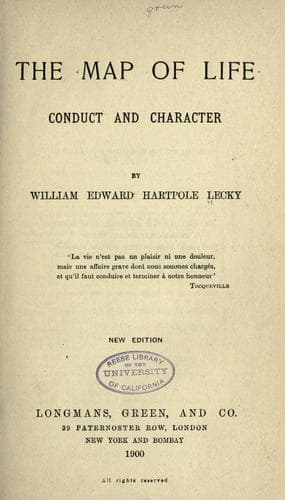
The Map of Life: Conduct and CharacterLecky, William Edward Hartpole
Philosophy
The Map of Life: Conduct and Character
Lecky, William Edward Hartpole
Character; Conduct of life
Some habits of thought also, that have grown rapidly among educated men,
have tended powerfully in the same direction. The sharp contrasts
between true and false in matters of theology have been considerably
attenuated. The point of view has changed. It is believed that in the
history of the world gross and material conceptions of religion have
been not only natural, but indispensable, and that it is only by a
gradual process of intellectual evolution that the masses of men become
prepared for higher and purer conceptions. Superstition and illusion
play no small part in holding together the great fabric of society.
'Every falsehood,' it has been said, 'is reduced to a certain
malleability by an alloy of truth,' and, on the other hand, truths of
the utmost moment are, in certain stages of the world's history, only
operative when they are clothed with a vesture of superstition. The
Divine Spirit filters down to the human heart through a gross and
material medium. And what is true of different stages of human history
is not less true of different contemporary strata of knowledge and
intelligence. In spite of democratic declamation about the equality of
man, it is more and more felt that the same kind of teaching is not good
for everyone. Truth, when undiluted, is too strong a medicine for many
minds. Some things which a highly cultivated intellect would probably
discard, and discard without danger, are essential to the moral being of
multitudes. There is in all great religious systems something that is
transitory and something that is eternal. Theological interpretations of
the phenomena of outward nature which surround and influence us, and
mythological narratives which have been handed down to us from a remote,
uncritical and superstitious past, may be transformed or discredited;
but there are elements in religion which have their roots much less in
the reason of man than in his sorrows and his affections, and are the
expression of wants, moral appetites and aspirations which are an
essential, indestructible part of his nature.
Public-domain text, read in full here on John Shaqi.
Reviews
Reviews
No reviews yet
Be the first to share your thoughts on this work.
Elsewhere in the archive
Join the Discussion
Join the discussion
Sign in to leave a comment or review.
Sign InorCreate an account