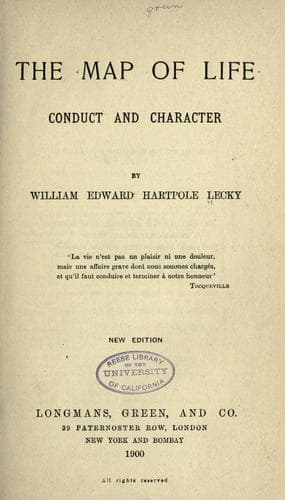
The Map of Life: Conduct and CharacterLecky, William Edward Hartpole
Philosophy
The Map of Life: Conduct and Character
Lecky, William Edward Hartpole
Character; Conduct of life
believe in dreams; the disappearance of superstition is not due to the
cultivation of reason or the spread of knowledge, but purely to the
mechanical effect of reading, which so perpetually puts figures and
aërial shapes before the mental gaze that in time those that occur
naturally are thought no more of than those conjured into existence by a
book. It is in far-away country places, where people read very little,
that they see phantoms and consult the oracles of fate. Their dreams are
real.'[66]
The last point I would notice in the management of character is the
importance of what may be called moral safety-valves. One of the most
fatal mistakes in education is the attempt which is so often made by the
educator to impose his own habits and tastes on natures that are
essentially different. It is common for men of lymphatic temperaments,
of studious, saintly, and retiring tastes, to endeavor to force a
high-spirited young man starting in life into their own mould--to
prescribe for him the cast of tastes and pursuits they find most suited
for themselves, forgetting that such an ideal can never satisfy a wholly
different nature, and that in aiming at it a kind of excellence which
might easily have been attained is missed. This is one of the evils
that very frequently arise when the education of boys after an early age
is left in the hands of women. It is the true explanation of the fact,
which has so often been noticed, that children of clergymen, or at least
children educated on a rigidly austere, puritanical system, so often go
conspicuously to the bad. Such an education, imposed on a nature that is
unfit for it, generally begins by producing hypocrisy, and not
unfrequently ends by a violent reaction into vice. There is no greater
mistake in education than to associate virtue in early youth with gloomy
colours and constant restrictions, and few people do more mischief in
the world than those who are perpetually inventing crimes. In circles
where smoking, or field sports, or going to the play, or reading novels,
or indulging in any boisterous games or in the most harmless Sunday
amusements, are treated as if they were grave moral offences, young men
constantly grow up who end by looking on grave moral offences as not
worse than these things. They lose all sense of proportion and
perspective in morals, and those who are always straining at gnats are
often peculiarly apt to swallow camels. It is quite right that men who
have formed for themselves an ideal of life of the kind that I have
described should steadily pursue it, but it is another thing to impose
it upon others, and to prescribe it as of general application. By
teaching as absolutely wrong things that are in reality only culpable in
their abuse or their excess, they destroy the habit of moderate and
restrained enjoyment, and a period of absolute prohibition is often
followed by a period of unrestrained license.
Public-domain text, read in full here on John Shaqi.
Reviews
Reviews
No reviews yet
Be the first to share your thoughts on this work.
Elsewhere in the archive
Join the Discussion
Join the discussion
Sign in to leave a comment or review.
Sign InorCreate an account