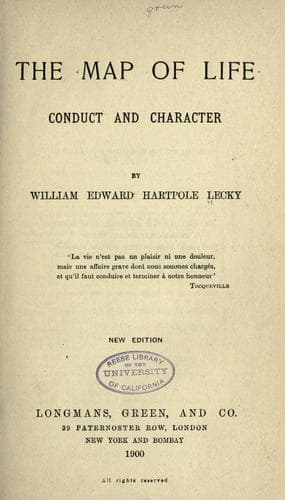
The Map of Life: Conduct and CharacterLecky, William Edward Hartpole
Philosophy
The Map of Life: Conduct and Character
Lecky, William Edward Hartpole
Character; Conduct of life
It is of course true that the power of a man thus to regulate his
expenditure is by no means absolute. The position in society in which a
man is born brings with it certain conventionalities and obligations
that cannot be discarded. A great nobleman who has inherited a vast
estate and a conspicuous social position will, through no fault of his
own, find himself involved in constant difficulties and struggles on an
income a tenth part of which would suffice to give a simple private
gentleman every reasonable enjoyment in life. A poor clergyman who is
obliged to keep up the position of a gentleman is in reality a much
poorer man than a prosperous artizan, even though his actual income may
be somewhat larger. But within the bounds which the conventionalities of
society imperatively prescribe many scales of expenditure are possible,
and the wise regulation of these is one of the chief forms of practical
wisdom.
It may be observed, however, that not only men but nations differ widely
in this respect, and the difference is not merely that between prudence
and folly, between forethought and passion, but is also in a large
degree a difference of tastes and ideals. In general it will be found
that in Continental nations a man of independent fortune will place his
expenditure more below his means than in England, and a man who has
pursued some lucrative employment will sooner be satisfied with the
competence he has acquired and will gladly exchange his work for a life
of leisure. The English character prefers a higher rate of expenditure
and work continued to the end.
It is probable that, so far as happiness depends on money, the happiest
lot--though it is certainly not that which is most envied--is that of a
man who possesses a realised fortune sufficient to save him from serious
money cares about the present and the future, but who at the same time
can only keep up the position in society he has chosen for himself, and
provide as he desires for his children, by adding to it a professional
income. Work is necessary both to happiness and to character, and
experience shows that it most frequently attains its full concentration
and continuity when it is professional, or, in other words,
money-making. Men work in traces as they will seldom work at liberty.
The compulsory character, the steady habits, the constant emulation of
professional life mould and strengthen the will, and probably the
happiest lot is when this kind of work exists, but without the anxiety
of those who depend solely on it.
Public-domain text, read in full here on John Shaqi.
Reviews
Reviews
No reviews yet
Be the first to share your thoughts on this work.
Elsewhere in the archive
Join the Discussion
Join the discussion
Sign in to leave a comment or review.
Sign InorCreate an account