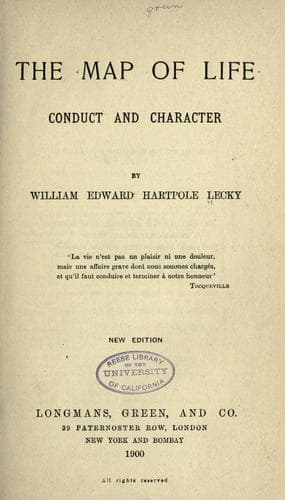
The Map of Life: Conduct and CharacterLecky, William Edward Hartpole
Philosophy
The Map of Life: Conduct and Character
Lecky, William Edward Hartpole
Character; Conduct of life
'It is almost a definition of a gentleman to say he is one who never
inflicts pain.... He carefully avoids whatever may cause a jar or a jolt
in the minds of those with whom he is cast--all clashing of opinion or
collision of feeling, all restraint or suspicion or gloom or resentment;
his great concern being to make everyone at ease and at home. He has his
eyes on all his company; he is tender towards the bashful, gentle
towards the distant, and merciful towards the absurd; he can recollect
to whom he is speaking; he guards against unreasonable allusions or
topics that may irritate; he is seldom prominent in conversation, and
never wearisome. He makes light of favours while he does them, and seems
to be receiving when he is conferring. He never speaks of himself except
when compelled, never defends himself by a mere retort; he has no ears
for slander or gossip, is scrupulous in imputing motives to those who
interfere with him, and interprets everything for the best. He is never
mean or little in his disputes, never takes an unfair advantage, never
mistakes personalities or sharp sayings for arguments, or insinuates
evil which he dare not say out.... He has too much good sense to be
affronted at insult; he is too busy to remember injuries, and too
indolent to bear malice.... If he engages in controversy of any kind his
disciplined intellect preserves him from the blundering discourtesy of
better though less educated minds, who, like blunt weapons, tear and
hack instead of cutting clean.... He may be right or wrong in his
opinion, but he is too clear-headed to be unjust; he is as simple as he
is forcible, and as brief as he is decisive. Nowhere shall we find
greater candour, consideration, indulgence. He throws himself into the
minds of his opponents, he accounts for their mistakes. He knows the
weakness of human nature as well as its strength, its province, and its
limits.'[73]
Public-domain text, read in full here on John Shaqi.
Reviews
Reviews
No reviews yet
Be the first to share your thoughts on this work.
Elsewhere in the archive
Join the Discussion
Join the discussion
Sign in to leave a comment or review.
Sign InorCreate an account