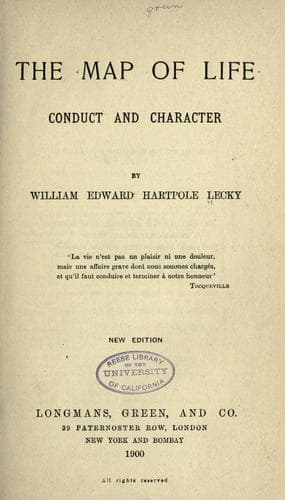
The Map of Life: Conduct and CharacterLecky, William Edward Hartpole
Philosophy
The Map of Life: Conduct and Character
Lecky, William Edward Hartpole
Character; Conduct of life
Some men have claimed for sleep even more than this. 'The night-time of
the body,' an ancient writer has said, 'is the day-time of the soul,'
and some, who do not absolutely hold the old belief that it is in the
dreams of the night that the Divine Spirit most communicates with man,
have, nevertheless, believed that the complete withdrawal of our minds
from those worldly cares which haunt our waking hours and do so much to
materialise and harden our natures is one of the first conditions of a
higher life. 'In proportion,' said Swedenborg, 'as the mind is capable
of being withdrawn from things sensual and corporeal, in the same
proportion it is elevated into things celestial and spiritual.' It has
been noticed that often thoughts and judgments, scattered and entangled
in our evening hours, seem sifted, clarified, and arranged in sleep;
that problems which seemed hopelessly confused when we lay down are at
once and easily solved when we awake, 'as though a reason more perfect
than reason had been at work when we were in our beds.' Something
analogous to this, it has been contended, takes place in our moral
natures. 'A process is going on in us during those hours which is not,
and cannot be, brought so effectually, if at all, at any other time, and
we are spiritually growing, developing, ripening more continuously while
thus shielded from the distracting influences of the phenomenal world
than during the hours in which we are absorbed in them.... Is it not
precisely the function of sleep to give us for a portion of every day in
our lives a respite from worldly influences which, uninterrupted, would
deprive us of the instruction, of the spiritual reinforcements,
necessary to qualify us to turn our waking experiences of the world to
the best account without being overcome by them? It is in these hours
that the plans and ambitions of our external worldly life cease to
interfere with or obstruct the flow of the Divine life into the
will.'[75]
Without, however, following this train of thought, it is at least
sufficiently clear that no small portion of the happiness of life
depends upon our sleeping hours. Plato has exhorted men to observe
carefully their dreams as indicating their natural dispositions,
tendencies, and temptations, and--perhaps with more reason--Burton and
Franklin have proposed 'the art of procuring pleasant dreams' as one of
the great, though little recognised, branches of the science of life.
This is, no doubt, mainly a question of diet, exercise, efficient
ventilation, and a wise distribution of hours, but it is also largely
influenced by moral causes.
Somnia quæ mentes ludunt volitantibus umbris,
Nec delubra deum, nec ab æthere numina mittunt,
Sed sibi quisque facit.
Public-domain text, read in full here on John Shaqi.
Reviews
Reviews
No reviews yet
Be the first to share your thoughts on this work.
Elsewhere in the archive
Join the Discussion
Join the discussion
Sign in to leave a comment or review.
Sign InorCreate an account