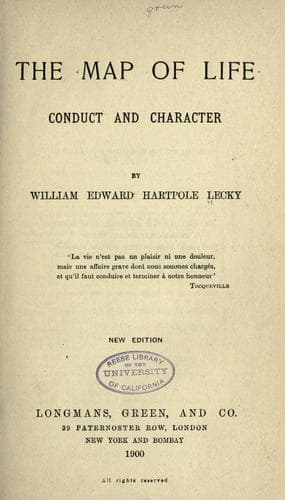
The Map of Life: Conduct and CharacterLecky, William Edward Hartpole
Philosophy
The Map of Life: Conduct and Character
Lecky, William Edward Hartpole
Character; Conduct of life
In highly civilised ages the same spirit may be clearly traced. Bossuet
was certainly no hypocrite or sycophant, but a man of austere virtue and
undoubted courage. He did not hesitate to rebuke the gross profligacy
of the life of Louis XIV., and although neither he nor any of the other
Catholic divines of his age seriously protested against the wars of pure
egotism and ostentation which made that sovereign the scourge of Europe
and brought down upon his people calamities immeasurably greater than
the faults of his private life--although, indeed, he has spoken of those
wars in language of rapturous and unqualified eulogy[16]--he had at
least the grace to devote a chapter of his 'Politique tirée de
l'Écriture Sainte' to the theme that 'God does not love war.' But in the
eyes of Bossuet the dominant fact in the life of Louis XIV. was the
Revocation of the Edict of Nantes and the savage persecution of the
Huguenots, and this was sufficient to place him among the best of
sovereigns.[17]
To those who will candidly consider the subject there is nothing in this
which need excite surprise. The doctrine that the Catholic Church is the
inspired guide, representing the voice of the Divinity on earth and
deciding with absolute authority all questions of right and wrong, very
naturally led to the conviction that nothing which was conducive to its
interests could be really criminal, and in all departments of morals it
regulated the degrees of praise and blame. The doctrine which is still
so widely professed but now so faintly realised, that the first
essential to salvation is orthodox belief, placed conduct on a lower
plane of importance than dogma, while the conviction that it is in the
power of man to obtain absolute certainty in religious belief, that
erroneous belief is in the eyes of the Almighty a crime bringing with it
eternal damnation, and that the teacher of heresy is the greatest enemy
of mankind, at once justified in the eyes of the believer acts which now
seem the gravest moral aberrations. Many baser motives and elements no
doubt mingled with the long and hideous history of the religious
persecutions of Christendom, but in the eyes of countless conscientious
men this teaching seemed amply sufficient to justify them and to stifle
all feeling of compassion for the victims. Much the same considerations
explain the absolute indifference with which so many good men witnessed
those witch persecutions which consigned thousands of old, feeble and
innocent women to torture and to death.
Public-domain text, read in full here on John Shaqi.
Reviews
Reviews
No reviews yet
Be the first to share your thoughts on this work.
Join the Discussion
Join the discussion
Sign in to leave a comment or review.
Sign InorCreate an account