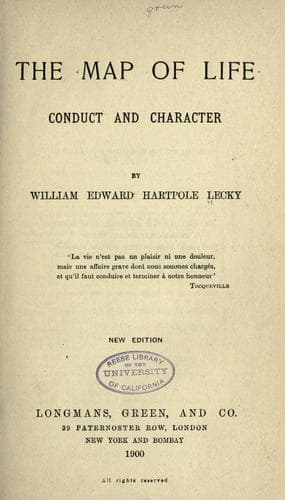
The Map of Life: Conduct and CharacterLecky, William Edward Hartpole
Philosophy
The Map of Life: Conduct and Character
Lecky, William Edward Hartpole
Character; Conduct of life
The gradual, silent and half-unconscious modification in the type of
Morals which took place after the Reformation was certainly not the
least important of its results. If it may be traced in some degree to
the distinctive theology of the Protestant Churches, it was perhaps
still more due to the abolition of clerical celibacy which placed the
religious teachers in the centre of domestic life and in close contact
with a large circle of social duties. There is even now a distinct
difference between the morals of a sincerely Catholic and a sincerely
Protestant country, and this difference is not so much, as
controversialists would tell us, in the greater and the less as in the
moral type, or, in other words, in the different degrees of importance
attached to different virtues and vices. Probably nowhere in the world
can more beautiful and more reverent types be found than in some of the
Catholic countries of Europe which are but little touched by the
intellectual movements of the age, but no good observer can fail to
notice how much larger is the place given to duties which rest wholly on
theological considerations, and how largely even the natural duties are
based on such considerations and governed, limited, and sometimes even
superseded by them. The ecclesiastics who at the Council of Constance
induced Sigismund to violate the safe-conduct he had given, and, in
spite of his solemn promise, to condemn Huss to a death of fire,[14] and
the ecclesiastics who at the Diet of Worms vainly tried to induce
Charles V. to act with a similar perfidy towards Luther, represent a
conception of morals which is abundantly prevalent in our day. It is no
exaggeration to say that in Catholic countries the obligation of
truthfulness in cases in which it conflicts with the interests of the
Church rests wholly on the basis of honour, and not at all on the basis
of religion. In the estimates of Catholic rulers no impartial observer
can fail to notice how their attitude towards the interest of the Church
dominates over all considerations of public and private morals.
In past ages this was much more the case. The Church filled in the minds
of men a place at least equal to that of the State in the Roman
Republic. Men who had made great sacrifices for it and rendered great
services to it were deemed, beyond all others, the good men, and in
those men things which we should regard as grossly criminal appeared
mere venial frailties. Let any one who doubts this study the lives of
the early Catholic saints, and the still more instructive pages in which
Gregory of Tours and other ecclesiastical annalists have described the
characters and acts of the more prominent figures in the secular history
of their times, and he will soon feel that he has passed into a moral
atmosphere and is dealing with moral measurements and perspectives
wholly unlike those of our own day.[15]
Public-domain text, read in full here on John Shaqi.
Reviews
Reviews
No reviews yet
Be the first to share your thoughts on this work.
Join the Discussion
Join the discussion
Sign in to leave a comment or review.
Sign InorCreate an account