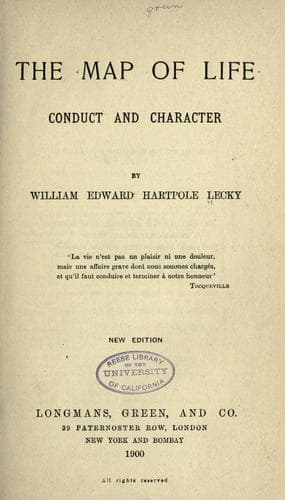
The Map of Life: Conduct and CharacterLecky, William Edward Hartpole
Philosophy
The Map of Life: Conduct and Character
Lecky, William Edward Hartpole
Character; Conduct of life
It is, I think, a peculiarity of modern times that the chief moral
influences are much more various and complex than in the past. There is
no such absolute empire as that which was exercised over character by
the State in some periods of Pagan antiquity and by the Church during
the Middle Ages. Our civilisation is more than anything else an
industrial civilisation, and industrial habits are probably the
strongest in forming the moral type to which public opinion aspires.
Slavery, which threw a deep discredit on industry and on the qualities
it fosters, has passed away. The feudal system, which placed industry in
an inferior position, has been abolished, and the strong modern tendency
to diminish both the privileges and the exclusiveness of rank and to
increase the importance of wealth is in the same direction. An
industrial society has its special vices and failings, but it naturally
brings into the boldest relief the moral qualities which industry is
most fitted to foster and on which it most largely depends, and it also
gives the whole tone of moral thinking a utilitarian character. It is
not Christianity but Industrialism that has brought into the world that
strong sense of the moral value of thrift, steady industry, punctuality
in observing engagements, constant forethought with a view to providing
for the contingencies of the future, which is now so characteristic of
the moral type of the most civilised nations.
Many other influences, however, have contributed to intensify, qualify,
or impair the industrial type. Protestantism has disengaged primitive
Christian ethics from a crowd of superstitious and artificial duties
which had overlaid them, and a similar process has been going on in
Catholic countries under the influence of the rationalising and
sceptical spirit. The influence of dogmatic theology on Morals has
declined. Out of the vast and complex religious systems of the past, an
eclectic spirit is bringing into special and ever-increasing prominence
those Christian virtues which are most manifestly in accordance with
natural religion and most clearly conducive to the well-being of men
upon the earth. Philanthropy or charity, which forms the centre of the
system, has also been immensely intensified by increased knowledge and
realisation of the wants and sorrows of others; by the sensitiveness to
pain, by the softening of manners and the more humane and refined tastes
and habits which a highly elaborated intellectual civilisation naturally
produces. The sense of duty plays a great part in modern philanthropy,
and lower motives of ostentation or custom mingle largely with the
genuine kindliness of feeling that inspires it; but on the whole it is
probable that men in our day, in doing good to others, look much more
exclusively than in the past to the benefit of the recipient and much
less to some reward for their acts in a future world. As long, too, as
this benefit is attained, they will gladly diminish as much as possible
Public-domain text, read in full here on John Shaqi.
Reviews
Reviews
No reviews yet
Be the first to share your thoughts on this work.
Elsewhere in the archive
Join the Discussion
Join the discussion
Sign in to leave a comment or review.
Sign InorCreate an account