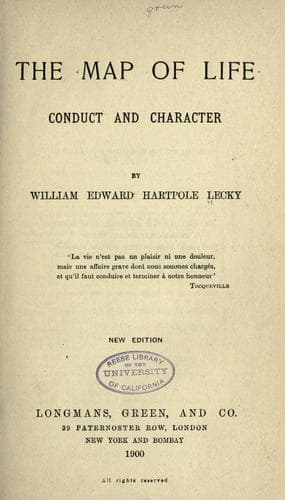
The Map of Life: Conduct and CharacterLecky, William Edward Hartpole
Philosophy
The Map of Life: Conduct and Character
Lecky, William Edward Hartpole
Character; Conduct of life
It is probable that as the world goes on morals will move more and more
in the direction I have described. There will be at the same time a
steadily increasing tendency to judge moral qualities and courses of
conduct mainly by the degree in which they promote or diminish human
happiness. Enthusiasm and self-sacrifice for some object which has no
real bearing on the welfare of man will become rarer and will be less
respected, and the condemnation that is passed on acts that are
recognised as wrong will be much more proportioned than at present to
the injury they inflict. Some things, such as excessive luxury of
expenditure and the improvidence of bringing into the world children for
whom no provision has been made, which can now scarcely be said to enter
into the teaching of moralists, or at least of churches, may one day be
looked upon as graver offences than some that are in the penal code.
FOOTNOTES:
[11] St. Francis de Sales.
[12] St. Philip Neri.
[13] St. Teresa.
[14] 'Cum dictus Johannes Hus fidem orthodoxam pertinaciter impugnans,
se ab omni con ductu et privilegio reddiderit alienum, nec aliqua sibi
fides aut promissio de jure naturali divino vel humano, fuerit in
præjudicium Catholicæ fidei observanda.' Declaration of the Council of
Constance. See Creighton's _History of the Papacy_, ii. 32.
[15] I have collected some illustrations of this in my _History of
European Morals_, ii. 235-242.
[16] See, e.g. his funeral oration on Marie Thérèse d'Autriche.
[17] See the enthusiastic eulogy of the persecution of the Huguenots in
his funeral oration on Michel le Tellier. It concludes: 'Épanchons nos
coeurs sur la piété de Louis; poussons jusqu'au ciel nos acclamations,
et disons à ce nouveau Constantin, à ce nouveau Théodose, à ce nouveau
Marcien, à ce nouveau Charlemagne ce que les six cent trente Pères
dirent autrefois dans le Concile de Chalcédoine: "Vous avez affermi la
foi; vous avez exterminé les hérétiques; c'est le digne ouvrage de votre
règne; c'en est le propre caractère. Par vous l'hérésie n'est plus, Dieu
seul a pu faire cette merveille. Roi du ciel, conservez le roi de la
terre; c'est le voeu, des Églises; c'est le voeu des Évêques."'
[18] See Migne, _Encyclopédie Théologique_, 'Dict. de Cas de
Conscience,' art. _Avortement_.
[19] See on this subject my _History of Rationalism_, ii. 250-270, and
my _Democracy and Liberty_, ii., ch. viii.
[20] 21 James I. c. 20; 19 Geo. II. c. 21. The penalties, however, were
fines, the pillory, or short periods of imprisonment. The obligation of
reading the statute in churches was abolished in 1823, but the custom
had before fallen into desuetude. In 1772 a vicar was (as an act of
private vengeance) prosecuted and fined for having neglected to read it.
(_Annual Register_, 1772, p. 115.)
Public-domain text, read in full here on John Shaqi.
Reviews
Reviews
No reviews yet
Be the first to share your thoughts on this work.
Elsewhere in the archive
Join the Discussion
Join the discussion
Sign in to leave a comment or review.
Sign InorCreate an account