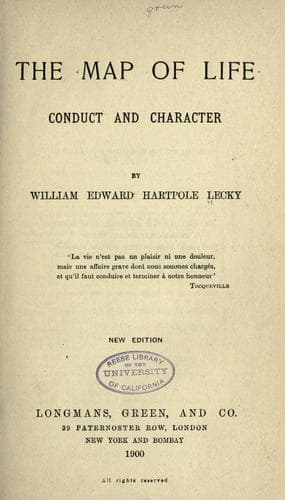
The Map of Life: Conduct and CharacterLecky, William Edward Hartpole
Philosophy
The Map of Life: Conduct and Character
Lecky, William Edward Hartpole
Character; Conduct of life
Nor indeed even in this latter case is a really accurate judgment
possible. Men are born into the world with both wills and passions of
varying strength, though in mature life the strength or weakness of each
is largely due to their own conduct. With different characters the same
temptation, operating under the same external circumstances, has
enormously different strength, and very few men can fully realise the
strength of a passion which they have never themselves experienced. To
repeat an illustration I have already used, how difficult is it for a
constitutionally sober man to form in his own mind an adequate
conception of the force of the temptation of drink to a dipsomaniac, or
for a passionless man to conceive rightly the temptations of a
profoundly sensual nature! I have spoken in a former chapter of the
force with which bodily conditions act upon happiness. Their influence
on morals is not less terrible. There are diseases well known to
physicians which make the most placid temper habitually irritable;
give a morbid turn to the healthiest disposition; fill the purest
mind with unholy thoughts. There are others which destroy the force
of the strongest will and take from character all balance and
self-control.[23] It often happens that we have long been blaming a man
for manifest faults of character till at last suicide, or the disclosure
of some grave bodily or mental disease which has long been working
unperceived, explains his faults and turns our blame into pity. In
madness the whole moral character is sometimes reversed, and tendencies
which have been in sane life dormant or repressed become suddenly
supreme. In such cases we all acknowledge that there is no moral
responsibility, but madness, with its illusions and irresistible
impulses, and idiocy with its complete suspension of the will and of the
judgment, are neither of them, as lawyers would pretend, clearly defined
states, marked out by sharp and well-cut boundaries, wholly distinct
from sanity. There are incipient stages; there are gradual
approximations; there are twilight states between sanity and insanity
which are clearly recognised not only by experts but by all sagacious
men of the world. There are many who are not sufficiently mad to be shut
up, or to be deprived of the management of their properties, or to be
exempted from punishment if they have committed a crime, but who, in the
common expressive phrase, 'are not all there'--whose eccentricities,
illusions and caprices are on the verge of madness, whose judgments are
hopelessly disordered; whose wills, though not completely atrophied, are
manifestly diseased. In questions of property, in questions of crime, in
questions of family arrangements, such persons cause the gravest
perplexity, nor will any wise man judge them by the same moral standard
as well-balanced and well-developed natures.
Public-domain text, read in full here on John Shaqi.
Reviews
Reviews
No reviews yet
Be the first to share your thoughts on this work.
Elsewhere in the archive
Join the Discussion
Join the discussion
Sign in to leave a comment or review.
Sign InorCreate an account