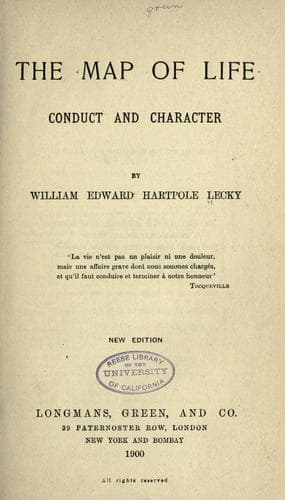
The Map of Life: Conduct and CharacterLecky, William Edward Hartpole
Philosophy
The Map of Life: Conduct and Character
Lecky, William Edward Hartpole
Character; Conduct of life
The conduct of Phillips in this case has, I believe, been justified by
the preponderance of professional opinion, though when the facts were
known public opinion outside the profession generally condemned it. Some
lawyers have pushed the duty of defence to a point which has aroused
much protest even in their own profession. 'The Advocate,' said Lord
Brougham in his great speech before the House of Lords in defence of
Queen Caroline, 'by the sacred duty which he owes his client, knows in
the discharge of that office but one person in the world--that client
and none other. To save that client by all expedient means, to protect
that client at all hazards and costs to all others, and among others to
himself, is the highest and most unquestioned of his duties; and he must
not regard the alarm, the suffering, the torment, the destruction which
he may bring upon any other. Nay, separating even the duties of a
patriot from those of an advocate, and casting them, if need be, to the
wind, he must go on, reckless of consequences, if his fate it should
unhappily be to involve his country in confusion for his client's
protection.'
This doctrine has been emphatically repudiated by some eminent English
lawyers, but both in practice and theory the profession have differed
widely in different courts, times and countries. How far, for example,
is it permissible in cross-examination to browbeat or confuse an honest
but timid and unskilful witness; to attempt to discredit the evidence of
a witness on a plain matter of fact about which he had no interest in
concealment by exhuming against him some moral scandal of early youth
which was totally unconnected with the subject of the trial; or, by
pursuing such a line of cross-examination, to keep out of the
witness-box material witnesses who are conscious that their past lives
are not beyond reproach? How far is it right or permissible to press
legal technicalities as opposed to substantial justice? Probably most
lawyers, if they are perfectly candid, will agree that these things are
in some measure inevitable in their profession, and that the real
question is one of degree, and therefore not susceptible of positive
definition. There is a kind of mind that grows so enamoured with the
subtleties and technicalities of the law that it delights in the
unexpected and unintended results to which they may lead. I have heard
an English judge say of another long deceased that he had through this
feeling a positive pleasure in injustice, and one lawyer, not of this
country, once confessed to me the amusement he derived from breaking the
convictions of criminals in his state by discovering technical flaws in
their indictments. There is a class of mind that delights in such cases
as that of the legal document which was invalidated because the letters
A.D. were put before the date instead of the formula 'in the year of Our
Lord,' or that of a swindler who was suffered to escape with his booty
Public-domain text, read in full here on John Shaqi.
Reviews
Reviews
No reviews yet
Be the first to share your thoughts on this work.
Elsewhere in the archive
Join the Discussion
Join the discussion
Sign in to leave a comment or review.
Sign InorCreate an account