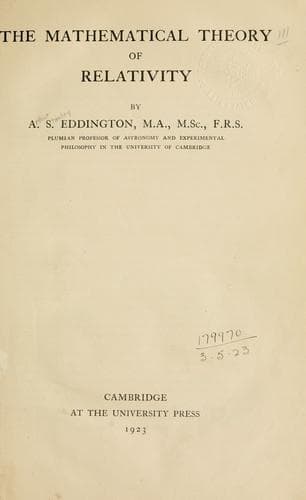
The Mathematical Theory of RelativityEddington, Arthur Stanley, Sir
Science
The Mathematical Theory of Relativity
Eddington, Arthur Stanley, Sir
Relativity (Physics)
In flat space-time the interval, referred to spherical polar coordinates and
time, is
\[
ds^{2} = -dr^{2} - r^{2}\, d\theta^{2} - r^{2} \sin^{2}\theta\, d\phi^{2} + dt^{2}.
\Tag{(38.11)}
\]
If we consider what modifications of this can be made without destroying the
spherical symmetry in space, the symmetry as regards past and future time,
or the static condition, the most general possible form appears to be
\[
ds^{2} = -U(r)\, dr^{2} - V(r)\, (r^{2}\, d\theta^{2} + r^{2} \sin^{2}\theta\, d\phi^{2}) + W(r)\, dt^{2},
\Tag{(38.12)}
\]
where $U$, $V$, $W$ are arbitrary functions of~$r$. Let
\[
r_{1}^{2} = r^{2} V(r).
\]
Then \Eq{(38.12)} becomes of the form
\[
ds^{2} = - U_{1}(r_{1})\, dr_{1}^{2} - r_{1}^{2}\, d\theta^{2} - r_{1}^{2} \sin^{2}\theta\, d\phi^{2} + W_{1}(r_{1})\, dt^{2},
\Tag{(38.13)}
\]
where $U_{1}$ and $W_{1}$ are arbitrary functions of~$r_{1}$. There is no reason to regard
$r$ in~\Eq{(38.12)} as more immediately the counterpart of~$r$ in~\Eq{(38.11)} than $r_{1}$~is. If
the functions $U$, $V$, $W$ differ only slightly from unity, both $r$ and $r_{1}$ will have
approximately the properties of the radius-vector in Euclidean geometry; but
no length in non-Euclidean space can have exactly the properties of a Euclidean
radius-vector, and it is arbitrary whether we choose $r$ or~$r_{1}$ as its closest representative.
We shall here choose~$r_{1}$, and accordingly drop the suffix, writing
\Eq{(38.13)} in the form
\[
ds^{2} = -e^{\lambda}\, dr^{2} - r^{2}\, d\theta^{2} - r^{2} \sin^{2}\theta\, d\phi^{2} + e^{\nu}\, dt^{2},
\Tag{(38.2)}
\]
where $\lambda$ and~$\nu$ are functions of $r$~only.
Moreover since the gravitational field (or disturbance of flat space-time)
due to a particle diminishes indefinitely as we go to an infinite distance, we
must have $\lambda$ and~$\nu$ tend to zero as $r$~tends to infinity. Formula~\Eq{(38.2)} will
then reduce to~\Eq{(38.11)} at an infinite distance from the particle.
Our coordinates are
\[
x_{1} = r,\quad
x_{2} = \theta,\quad
x_{3} = \phi,\quad
x_{4} = t,
\]
and the fundamental tensor is by~\Eq{(38.2)}
\[
g_{11} = -e^{\lambda},\
g_{22} = -r^{2},\
g_{33} = -r^{2} \sin^{2}\theta,\
g_{44} = e^{\nu},
\Tag{(38.31)}
\]
and
\[
g_{\mu\nu} = 0\quad\text{if $\mu \neq \nu$.}
\]
The determinant~$g$ reduces to its leading diagonal $g_{11} g_{22} g_{33} g_{44}$. Hence
\[
-g = e^{\lambda + \nu} r^{4} \sin^{2}\theta,
\Tag{(38.32)}
\]
and $g^{11} = 1/g_{11}$, etc., so that
\[
g^{11} = -e^{-\lambda},\ \
g^{22} = -1/r^{2},\ \
g^{33} = -1/r^{2} \sin^{2}\theta,\ \
g^{44} = e^{-\nu}.
\Tag{(38.33)}
\]
Since all the $g^{\mu\nu}$ vanish except when the two suffixes are the same, the
summation disappears in the formula for the $3$-index symbols~\Eq{(27.2)}, and
\[
\{\mu\nu, \sigma\}
= \tfrac{1}{2} g^{\tau\sigma}\left(
\frac{\dd g_{\mu\sigma}}{\dd x_{\nu}}
+ \frac{\dd g_{\nu\sigma}}{\dd x_{\mu}}
+ \frac{\dd g_{\mu\nu}}{\dd x_{\sigma}}
\right)\quad\text{not summed.}
\]
\PageSep{84}
Public-domain text, read in full here on John Shaqi.
Reviews
Reviews
No reviews yet
Be the first to share your thoughts on this work.
Elsewhere in the archive
Join the Discussion
Join the discussion
Sign in to leave a comment or review.
Sign InorCreate an account