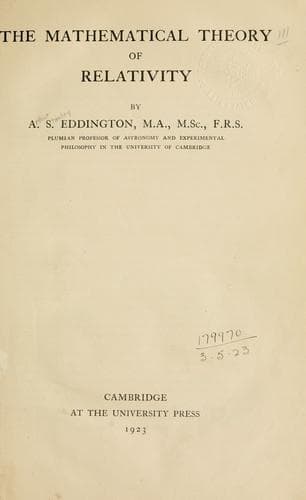
The Mathematical Theory of RelativityEddington, Arthur Stanley, Sir
Science
The Mathematical Theory of Relativity
Eddington, Arthur Stanley, Sir
Relativity (Physics)
We have to be on our guard against results of this latter kind which would
only be of interest if the radius-vector were a directly measured quantity instead
of a conventional coordinate. The advance of perihelion is a phenomenon
of a different category. Clearly the number of years required for an eccentric
orbit to make a complete revolution returning to its original position is capable
of observational test, unaffected by any convention used in defining the exact
length of the radius-vector.
For the four inner planets the following table gives the corrections to the
\index{Elements of inner planets}%
\index{Mercury, perihelion of}%
centennial motion of perihelion predicted by Einstein's theory:
\[
\begin{array}{l@{\qquad}l@{\qquad}l}
& \multicolumn{1}{c}{\delta\varpi} & \multicolumn{1}{c}{e\, \delta\varpi} \\
\text{Mercury} & +42''.9 & +8''.82 \\
\text{Venus} & +\PadTo[r]{42''}{8}.6 & +\PadTo[r]{8''}{0}.05 \\
\text{Earth} & +\PadTo[r]{42''}{3}.8 & +\PadTo[r]{8''}{0}.07 \\
\text{Mars} & +\PadTo[r]{42''}{1}.35& +\PadTo[r]{8''}{0}.13 \\
\end{array}
\]
The product $e\, \delta\varpi$ is a better measure of the observable effect to be looked for,
and the correction is only appreciable in the case of Mercury. After applying
these corrections to~$e\, \delta\varpi$, the following discrepancies between theory and observation
remain in the secular changes of the elements of the inner planets,
$i$~and $\Omega$ being the inclination and the longitude of the node:
\[
\footnotesize
\begin{array}{lrrrr}
& \multicolumn{1}{c}{e\, \delta\varpi} & \multicolumn{1}{c}{\delta e} & \multicolumn{1}{c}{\sin i\, \delta\Omega} & \multicolumn{1}{c}{\delta i} \\
\text{Mercury} &
-0''.58 ± 0''.29 & -0''.88 ± 0''.33 & +0''.46 ± 0''.34 & +0''.38 ± 0''.54 \\
\text{Venus} &
-\PadTo[r]{0''}{0}.11 ± \PadTo[r]{0''}{0}.17 & +\PadTo[r]{0''}{0}.21 ± \PadTo[r]{0''}{0}.21 & +\PadTo[r]{0''}{0}.53 ± \PadTo[r]{0''}{0}.12 & + \PadTo[r]{0''}{0}.38 ± \PadTo[r]{0''}{0}.22 \\
\text{Earth} & \PadTo[r]{0''}{0}.00 ± \PadTo[r]{0''}{0}.09 & +\PadTo[r]{0''}{0}.02 ± \PadTo[r]{0''}{0}.07 & \PadTo{+0''.46}{\cdots} \quad \PadTo{0''.34}{\cdots} & -\PadTo[r]{0''}{0}.22 + \PadTo[r]{0''}{0}.18 \\
\text{Mars} & +\PadTo[r]{0''}{0}.51 ± \PadTo[r]{0''}{0}.23 & +\PadTo[r]{0''}{0}.29 ± \PadTo[r]{0''}{0}.18 & -\PadTo[r]{0''}{0}.11 ± \PadTo[r]{0''}{0}.15 & -\PadTo[r]{0''}{0}.01 ± \PadTo[r]{0''}{0}.13 \\
\end{array}
\]
\PageSep{90}
The probable errors here given include errors of observation, and also errors
in the theory due to uncertainty of the masses of the planets. The positive
sign indicates excess of observed motion over theoretical motion\footnotemark.\footnotetext
{Newcomb, \Title{Astronomical Constants}. His results have been slightly corrected by using a
modern value of the constant of precession in the above table; see de~Sitter, \Title{Monthly Notices},
vol.~76, p.~728.}
Public-domain text, read in full here on John Shaqi.
Reviews
Reviews
No reviews yet
Be the first to share your thoughts on this work.
Elsewhere in the archive
Join the Discussion
Join the discussion
Sign in to leave a comment or review.
Sign InorCreate an account