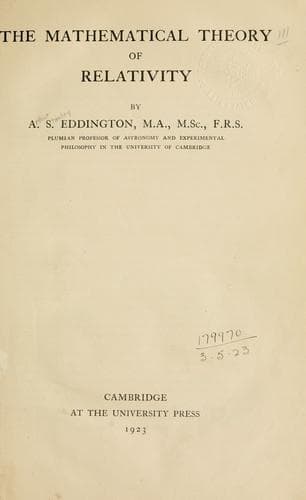
The Mathematical Theory of RelativityEddington, Arthur Stanley, Sir
Science
The Mathematical Theory of Relativity
Eddington, Arthur Stanley, Sir
Relativity (Physics)
It has been explained in \Title{Space, Time and Gravitation} that this deflection
is double that which might have been predicted on the Newtonian theory.
In this connection the following paradox has been remarked. Since the curvature
of the light-track is doubled, the acceleration of the light at each point
is double the Newtonian acceleration; whereas for a slowly moving object the
acceleration is practically the same as the Newtonian acceleration. To a man
in a lift descending with acceleration~$m/r^{2}$ the tracks of ordinary particles will
appear to be straight lines; but it looks as though it would require an acceleration~$2m/r^{2}$
to straighten out the light-tracks. Does not this contradict the
principle of equivalence?
The fallacy lies in a confusion between two meanings of the word ``curvature.''
\index{Acceleration of light-pulse}%
\index{Curvature of light-tracks}%
\index{Geodesic curvature}%
The \emph{coordinate} curvature obtained from the equation of the track~\Eq{(41.4)}
is not the \emph{geodesic} curvature. The latter is the curvature with which the local
observer---the man in the lift---is concerned. Consider the curved light-track
traversing the hummock corresponding to the sun's field; its curvature can be
reckoned by projecting it either on the base of the hummock or on the tangent
plane at any point. The curvatures of the two projections will generally be
different. The projection into Euclidean coordinates $(x, y)$ used in~\Eq{(41.4)} is the
projection on the base of the hummock; in applying the principle of equivalence
the projection is on the tangent plane, since we consider a region of the
curved world so small that it cannot be discriminated from its tangent plane.
\Section{42.}{Displacement of the Fraunhofer lines}
\index{Displacement of spectral lines to red, in sun}%
\index{Fraunhofer lines, displacement of}%
\index{Red-shift!of spectral lines in sun}%
\index{Spectral lines, displacement!in sun}%
Consider a number of similar atoms vibrating at different points in the
region. Let the atoms be momentarily at rest in our coordinate-system
$(r, \theta, \phi, t)$. The test of similarity of the atoms is that corresponding intervals
should be equal, and accordingly the \emph{interval} of vibration of all the atoms will
\index{Atom, time of vibration of}%
be the same.
Since the atoms are at rest we set $dr$, $d\theta$, $d\phi = 0$ in~\Eq{(38.8)}, so that
\[
ds^{2} = \gamma\, dt^{2}.
\Tag{(42.1)}
\]
\PageSep{92}
Accordingly the \emph{times} of vibration, of the differently placed atoms will be
inversely proportional to~$\sqrt{\gamma}$.
Public-domain text, read in full here on John Shaqi.
Reviews
Reviews
No reviews yet
Be the first to share your thoughts on this work.
Elsewhere in the archive
Join the Discussion
Join the discussion
Sign in to leave a comment or review.
Sign InorCreate an account