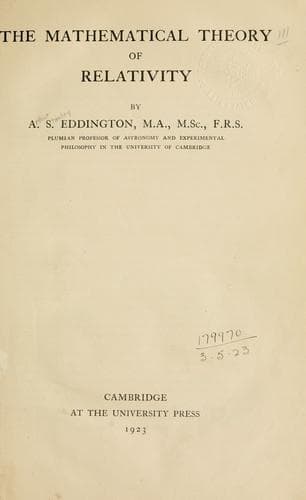
The Mathematical Theory of RelativityEddington, Arthur Stanley, Sir
Science
The Mathematical Theory of Relativity
Eddington, Arthur Stanley, Sir
Relativity (Physics)
We keep the axes $(\xi, \eta)$ permanently fixed; the angle~$\theta$ which gives the
direction of the sun (the old axis of~$x$) will change uniformly, and in the long
run take all values with equal frequency independently of the moon's position
in its orbit. We can only hope to observe the secular effects of the small forces
$\Xi$,~$\Eta$, accumulated through a long period of time. Accordingly, averaging the
trigonometrical functions, the secular terms are
\[
\left.
\begin{aligned}
\Xi &= -3\frac{m}{a^{2}}\, v\, \frac{d\eta}{dt}
= -2\omega\, \frac{d\eta}{dt}\Add{,} \\
\Eta &= \Neg 3\frac{m}{a^{2}}\, v\, \frac{d\xi}{dt}
= \Neg2\omega\, \frac{d\xi}{dt}\Add{,}
\end{aligned}
\right\}
\Tag{(44.5)}
\]
where
\[
\omega = \tfrac{3}{2}mv/a^{2}.
\Tag{(44.6)}
\]
If $(F_{\xi}, F_{\eta})$ is the Newtonian force, the equations of motion including these
secular perturbing forces will be
\[
\frac{d^{2}\xi}{dt^{2}} + 2\omega\, \frac{d\eta}{dt} = F_{\xi},\quad
\frac{d^{2}\eta}{dt^{2}} - 2\omega\, \frac{d\xi}{dt} = F_{\eta}.
\Tag{(44.7)}
\]
It is easily seen that $\omega$~is a very small quantity, so that $\omega^{2}$~is negligible.
The equations~\Eq{(44.7)} are then recognised as the Newtonian equations referred
to axes rotating with angular velocity~$-\omega$. Thus if we take the Newtonian
orbit and give it an angular velocity~$+\omega$, the result will be the solution of~\Eq{(44.7)}.
The leading correction to the lunar theory obtained from Einstein's
equations is a precessional effect, indicating that the classical results refer to
a frame of reference advancing with angular velocity~$\omega$ compared with the
general inertial frame of the solar system.
From this cause the moon's node and perigee will advance with velocity~$\omega$.
If $\Omega$~is the earth's angular velocity
\[
\frac{\omega}{\Omega} = \frac{3}{2}\, \frac{m}{a} = \tfrac{3}{2} · 10^{-8}.
\]
\PageSep{99}
Hence the advance of perigee and node in a century is
\[
3\pi · 10^{-6} \text{ radians} = 1''.94.
\]
We may notice the very simple theoretical relation that Einstein's corrections
cause an advance of the moon's perigee which is \emph{one half} the advance
of the earth's perihelion.
Neither the lunar theory nor the observations are as yet carried quite far
enough to take account of this small effect; but it is only a little below the
limit of detection. The result agrees with de~Sitter's value except in the second
decimal place which is only approximate.
There are well-known irregular fluctuations in the moon's longitude which
attain rather large values; but it is generally considered that these are not
of a type which can be explained by any amendment of gravitational theory
and their origin must be looked for in other directions. At any rate Einstein's
theory throws no light on them.
Public-domain text, read in full here on John Shaqi.
Reviews
Reviews
No reviews yet
Be the first to share your thoughts on this work.
Elsewhere in the archive
Join the Discussion
Join the discussion
Sign in to leave a comment or review.
Sign InorCreate an account