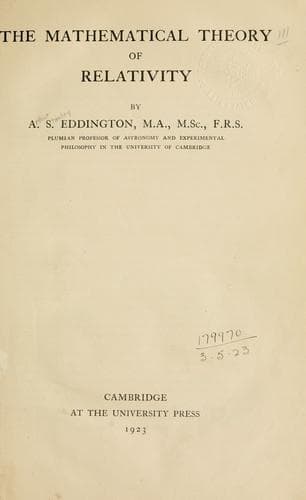
The Mathematical Theory of RelativityEddington, Arthur Stanley, Sir
Science
The Mathematical Theory of Relativity
Eddington, Arthur Stanley, Sir
Relativity (Physics)
We might write down at once by~\Eq{(14.1)}
\[
\sigma' = \sigma (1 - \omega^{2} r^{2})^{-\frac{1}{2}},
\]
since $\omega r$~is the velocity of the element. This would in fact give the right
result. But in \SecRef{14} acceleration was not taken into account and we ought to
\PageSep{113}
proceed more rigorously. We use the accented coordinates of \SecRef{15} for our
rotating system, and easily calculate from~\Eq{(15.4)} that
\[
\sqrt{-g'} = 1,
\]
and since $x_{1}'$, $x_{2}'$, $x_{3}'$ are constant for an element of the disc, the proper-time
\[
ds = \Chg{\surd\bigl(1 - \omega^{2}(x_{1}'^{2} + x_{2}'^{2})\bigr)\, dx_{4}'}
{\sqrt{1 - \omega^{2}(x_{1}'^{2} + x_{2}'^{2})}\, dx_{4}'}.
\]
If $dW$~is the proper-volume of the element, by~\Eq{(49.42)}
\[
dW\, ds = \sqrt{-g'} · dx_{1}'\, dx_{2}'\, dx_{3}'\, dx_{4}'.
\]
Hence
\begin{align*}
dW &= \bigl(1 - \omega^{2}(x_{1}'^{2} + x_{2}'^{2})\bigr)^{-\frac{1}{2}}\, dx_{1}'\, dx_{2}'\, dx_{3}' \\
&= (1 - \omega^{2} r^{2})^{-\frac{1}{2}}\, r'\, dr'\, d\theta'\, dx_{3}'.
\end{align*}
If the thickness of the disc is $\delta x_{3}' = b$, and its boundary is given by $r' = a'$,
the total number of particles in the disc will be
\[
N = \int \sigma\, dW
= 2\pi\sigma b \int_{0}^{a'} (1 - \omega^{2} r'^{2})^{-\frac{1}{2}}\, r'\, dr'.
\]
Since this number is unaltered by the rotation, $a'$~must be a function of~$\omega$
such that
\[
\int_{0}^{a'} (1 - \omega^{2} r^{2})^{-\frac{1}{2}}\, r'\, dr' = \text{const.},
\]
or
\[
\Chg{\frac{1}{\omega^{2}}\bigl(1 - \surd(1 - \omega^{2} a'^{2})\bigr)}
{\frac{1}{\omega^{2}}\bigl(1 - \sqrt{1 - \omega^{2} a'^{2}}\bigr)}
= \text{const.}
\]
Expanding the square-root, this gives approximately
\[
\tfrac{1}{2} a'^{2} (1 + \tfrac{1}{4} \omega^{2} a'^{2}) = \text{const.},
\]
so that if $a$~is the radius of the disc at rest
\[
a' = (1 + \tfrac{1}{8} \omega^{2} a'^{2}) = a.
\]
Hence to the same approximation
\[
a' = a (1 - \tfrac{1}{8} \omega^{2} a^{2}).
\]
Note that $a'$~is the radius of the rotating disc according to measurement with
fixed scales, since the rotating and non-rotating coordinates have been connected
by the elementary transformation~\Eq{(15.3)}.
We see that the contraction is one quarter of that predicted by a crude
application of the FitzGerald formula to the circumference.
\Section{51.}{The divergence of a tensor}
\index{Contracted derivative (divergence)}%
\index{Divergence!tensor@of a tensor}%
In the elementary theory of vectors the divergence
\[
\frac{\dd X}{\dd x} + \frac{\dd Y}{\dd y} + \frac{\dd Z}{\dd z}
\]
is important; we can to some extent grasp its geometrical significance. In
our general notation, this expression becomes
\[
\frac{\dd A^{\mu}}{\dd x_{\mu}}.
\]
\PageSep{114}
But evidently a more fundamental operation is to take the covariant derivatives
which will give an invariant
\[
(A^{\mu})_{\mu}.
\]
We therefore define the \emph{divergence} of a tensor as its contracted covariant
derivative.
Public-domain text, read in full here on John Shaqi.
Reviews
Reviews
No reviews yet
Be the first to share your thoughts on this work.
Elsewhere in the archive
Join the Discussion
Join the discussion
Sign in to leave a comment or review.
Sign InorCreate an account