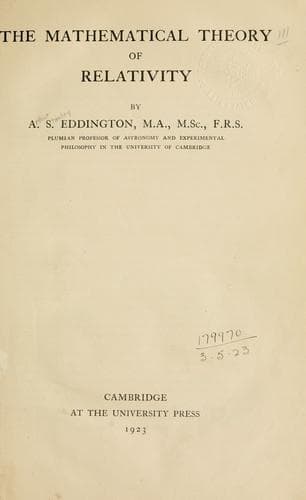
The Mathematical Theory of RelativityEddington, Arthur Stanley, Sir
Science
The Mathematical Theory of Relativity
Eddington, Arthur Stanley, Sir
Relativity (Physics)
According to the new point of view Einstein's law of gravitation does not
impose any limitation on the basal structure of the world. $G_{\mu\nu}$~may vanish or
it may not. If it vanishes we say that space is empty; if it does not vanish
we say that momentum or energy is present; and our practical test whether
space is occupied or not---whether momentum and energy exist there---is the
test whether $G_{\mu\nu}$~exists or not\footnotemark.\footnotetext
{We are dealing at present with mechanics only, so that we can scarcely discuss the part
played by electromagnetic fields (light) in conveying to us the impression that space is occupied
by something. But it may be noticed that the \emph{crucial} test is mechanical. A real image has the
optical properties but not the mechanical properties of a solid body.}
Moreover it is not an accident that it should be this particular tensor
which is capable of being recognised by us. It is because its divergence
vanishes---because it satisfies the law of conservation---that it fulfils the
primary condition for being recognised as substantial. If we are to surround
ourselves with a perceptual world at all, we must recognise as substance that
which has some element of permanence. We may not be able to explain how
the mind recognises as substantial the world-tensor $G_{\mu}^{\nu} - \frac{1}{2}g_{\mu}^{\nu} G$, but we can
see that it could not well recognise anything simpler. There are no doubt
\PageSep{121}
minds which have not this predisposition to regard as substantial the things
which are permanent; but we shut them up in lunatic asylums.
The invariant
\begin{align*}
T &= g_{\mu\nu} T^{\mu\nu} \\
&= g_{\mu\nu} · \rho_{0}\, \frac{dx_{\mu}}{ds}\, \frac{dx_{\nu}}{ds} \\
&= \rho_{0},
\end{align*}
since
\[
g_{\mu\nu}\, dx_{\mu}\, dx_{\nu} = ds^{2}.
\]
Thus
\[
G = 8\pi T = 8\pi \rho_{0}.
\Tag{(54.6)}
\]
Einstein and de~Sitter obtain a naturally curved world by taking instead
of~\Eq{(54.3)}
\[
G_{\mu}^{\nu} - \tfrac{1}{2}g_{\mu}^{\nu}(G - 2\lambda) = -8\pi T_{\mu}^{\nu},
\Tag{(54.71)}
\]
where $\lambda$~is a constant. Since the divergence of~$g_{\mu}^{\nu}$ or of~$g^{\mu\nu}$ vanishes, the
divergence of this more general form will also vanish, and the laws of conservation
of mass and momentum are still satisfied identically. Contracting
\Eq{(54.71)}, we have
\[
G - 4\lambda = 8\pi T = 8\pi \rho_{0}.
\Tag{(54.72)}
\]
For empty space $G = 4\lambda$, and $T_{\mu}^{\nu} = 0$; and thus the equation reduces to
\[
G_{\mu}^{\nu} = \lambda g_{\mu}^{\nu},
\]
or
\[
G_{\mu\nu} = \lambda g_{\mu\nu},
\]
as in~\Eq{(37.4)}.
Public-domain text, read in full here on John Shaqi.
Reviews
Reviews
No reviews yet
Be the first to share your thoughts on this work.
Elsewhere in the archive
Join the Discussion
Join the discussion
Sign in to leave a comment or review.
Sign InorCreate an account