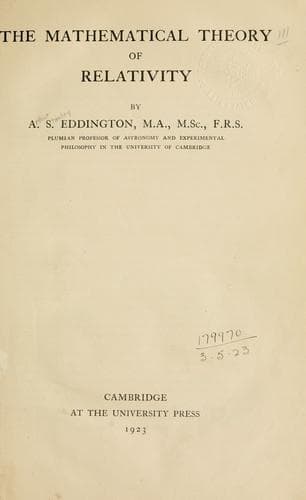
The Mathematical Theory of RelativityEddington, Arthur Stanley, Sir
Science
The Mathematical Theory of Relativity
Eddington, Arthur Stanley, Sir
Relativity (Physics)
For a liquid or solid the stress does not arise entirely from molecular
motions, but is due mainly to direct repulsive forces between the molecules held
in proximity. These stresses must, of course, be included in the energy-tensor
(which would otherwise not be conserved) just as the gaseous pressure is
included. It will be shown later that if these repulsive forces are Maxwellian
electrical forces they contribute nothing to~$\rho_{0}$, so that $\rho_{0}$~arises entirely from
the molecules individually (probably from the electrons individually) and is
independent of the circumstances of packing.
Since $\rho_{0}$~is the most useful of the three quantities in theoretical investigations
we shall in future call it the proper-density (or invariant density)
without qualification.
\Section{55.}{The force}
\index{Force, covariant and contravariant components!expressed by $3$-index symbols}%
By \Eq{(51.2)} the equation $(T_{\mu}^{\nu})_{\nu} = 0$ becomes
\[
\frac{1}{\sqrt{-g}}\, \frac{\dd}{\dd x_{\nu}}(T_{\mu}^{\nu} \sqrt{-g})
= \{\mu\nu, \alpha\} T_{\alpha}^{\nu}.
\Tag{(55.1)}
\]
Let us choose coordinates so that $\sqrt{-g} = 1$; then
\[
\frac{\dd}{\dd x_{\nu}}T_{\mu}^{\nu} = \{\mu\nu, \alpha\} T_{\alpha}^{\nu}.
\Tag{(55.2)}
\]
In most applications the velocity of the matter is extremely small compared
with the velocity of light, so that on the right of this equation $T_{4}^{4} = \rho$ is
much larger than the other components of~$T_{\alpha}^{\nu}$. As a first approximation we
neglect the other components, so that
\[
\frac{\dd}{\dd x_{\nu}} T_{\mu}^{\nu} = \{\mu4, 4\} \rho.
\Tag{(55.3)}
\]
\PageSep{123}
This will agree with classical mechanics~\Eq{(53.92)} if
\[
-X,\ -Y,\ -Z = \{14, 4\},\ \{24, 4\},\ \{34, 4\}.
\Tag{(55.4)}
\]
The $3$-index symbols can thus be interpreted as components of the field
of force. The three quoted are the leading components which act proportionately
to the mass or energy; the others, neglected in Newtonian mechanics,
are evoked by the momenta and stresses which form the remaining components
of the energy-tensor.
Public-domain text, read in full here on John Shaqi.
Reviews
Reviews
No reviews yet
Be the first to share your thoughts on this work.
Elsewhere in the archive
Join the Discussion
Join the discussion
Sign in to leave a comment or review.
Sign InorCreate an account