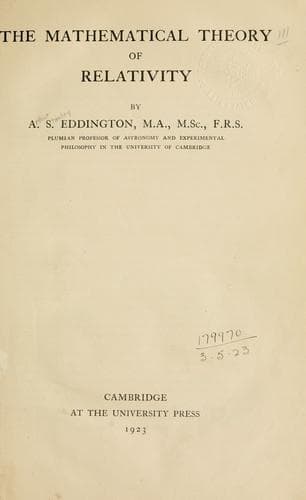
The Mathematical Theory of RelativityEddington, Arthur Stanley, Sir
Science
The Mathematical Theory of Relativity
Eddington, Arthur Stanley, Sir
Relativity (Physics)
Must we then conclude that the speed of propagation of gravitation is
necessarily a conventional conception without absolute meaning? I think not.
The speed of gravitation is quite definite; only the problem of determining
it does not seem to have yet been tackled correctly. To obtain a speed independent
of the coordinate-system chosen, we must consider the propagation
not of a world-tensor but of a world-invariant. The simplest world-invariant
for this purpose is $B_{\mu\nu\sigma}^{\epsilon} B_{\epsilon}^{\mu\nu\sigma}$, since $G$~and $G_{\mu\nu}G^{\mu\nu}$ vanish in empty space. It is
scarcely possible to treat of the propagation of an isolated pulse of gravitational
influence, because there seems to be no way of starting a sudden pulse
without calling in supernatural agencies which violate the equations of
mechanics. We may consider the regular train of waves caused by the earth
in its motion round the sun. At a distant point in the ecliptic $B_{\mu\nu\sigma}^{\epsilon} B_{\epsilon}^{\mu\nu\sigma}$ will
vary with an annual periodicity; if it has a maximum or minimum value at
the instant when the earth is \emph{seen} to transit the sun, the inference is that the
wave of disturbance has travelled to us at the same speed as the light. (It
may perhaps be objected that there is no proof that the disturbance has been
propagated from the earth; it might be a stationary wave permanently
located round the sun which is as much the cause as the effect of the earth's
annual motion. I do not think the objection is valid, but it requires examination.)
There does not seem to be any grave difficulty in treating this problem;
and it deserves investigation.
\Section{58.}{Lagrangian form of the gravitational equations}
The Lagrangian function~$\mf{L}$ is defined by
\index{Lagrangian function}%
\[
\mf{L} = g^{\mu\nu} \sqrt{-g}
\bigl(\{\mu\alpha, \beta\}\{\nu\beta, \alpha\}
- \{\mu\nu, \alpha\} \{\alpha\beta, \beta\}\bigr),
\Tag{(58.1)}
\]
which forms part of the expression for~$\mf{G}$ ($= g^{\mu\nu} G_{\mu\nu} \sqrt{-g}$). For any small
variation of~$\mf{L}$
\begin{multline*}
\delta\mf{L}
= \{\mu\alpha, \beta\}\, \delta\bigl(g^{\mu\nu} \sqrt{-g}\, \{\nu\beta, \alpha\}\bigr)
+ \{\nu\beta, \alpha\}\, \delta\bigl(g^{\mu\nu} \sqrt{-g}\, \{\mu\alpha, \beta\}\bigr) \\
- \{\mu\nu, \alpha\}\, \delta\bigl(g^{\mu\nu} \sqrt{-g}\, \{\alpha\beta, \beta\}\bigr)
- \{\alpha\beta, \beta\}\, \delta\bigl(g^{\mu\nu} \sqrt{-g}\, \{\mu\nu, \alpha\}\bigr) \\
- \bigl(\{\mu\alpha, \beta\}\, \{\nu\beta, \alpha\} - \{\mu\nu, \alpha\}\{\alpha\beta, \beta\}\bigr)
\delta\bigl(g^{\mu\nu} \sqrt{-g}\bigr).
\Tag{(58.2)}
\end{multline*}
%\PageSep{132}
Public-domain text, read in full here on John Shaqi.
Reviews
Reviews
No reviews yet
Be the first to share your thoughts on this work.
Elsewhere in the archive
Join the Discussion
Join the discussion
Sign in to leave a comment or review.
Sign InorCreate an account