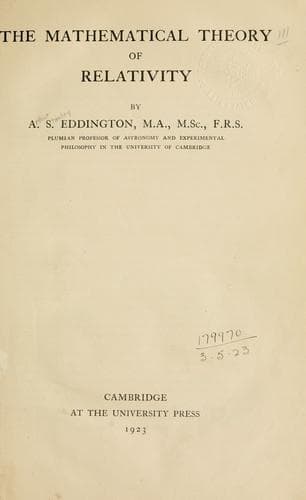
The Mathematical Theory of RelativityEddington, Arthur Stanley, Sir
Science
The Mathematical Theory of Relativity
Eddington, Arthur Stanley, Sir
Relativity (Physics)
Accordingly the difference between the relativity treatment and the
classical treatment is as follows. In both theories it is recognised that in
certain cases $\mf{T}_{\mu}^{\nu}$~is conserved, but that in the general case this conservation
breaks down. The relativity theory treats the general case by discovering a
more exact formulation of what happens to~$\mf{T}_{\mu}^{\nu}$ when it is not strictly conserved,
viz.\ $\mf{T}_{\mu\nu}^{\nu} = 0$. The classical theory treats it by introducing a supplementary
energy, so that conservation is still maintained but for a different quantity,
viz.\ $\dd\mf{S}_{\mu}^{\nu}/\dd x_{\nu} = 0$. The relativity treatment adheres to the physical quantity and
modifies the law; the classical treatment adheres to the law and modifies the
physical quantity. Of course, both methods should be expressible by equivalent
formulae; and we have in our previous work spoken of $\mf{T}_{\mu\nu}^{\nu} = 0$ as the law of
conservation of energy and momentum, because, although it is not formally
a law of conservation, it expresses exactly the phenomena which classical
mechanics attributes to conservation.
The relativity treatment has enabled us to discover the exact equations,
and we may now apply these to obtain the corresponding exact expression for
the quantity~$\mf{S}_{\mu}^{\nu}$ introduced in the classical treatment.
It is clear that $\mf{t}_{\mu}^{\nu}$ and therefore~$\mf{S}_{\mu}^{\nu}$ cannot be tensor-densities, because $\mf{t}_{\mu}^{\nu}$~vanishes
\index{Pseudo-energy-tensor}%
when natural coordinates are used at a point, and would therefore
always vanish if it were a tensor-density. We call~$\mf{t}_{\mu}^{\nu}$ the pseudo-tensor-density
of potential energy.
The explicit value of~$\mf{t}_{\mu}^{\nu}$ must be calculated from the condition~\Eq{(59.3)}, or
\begin{align*}
\frac{\dd\mf{t}_{\mu}^{\nu}}{\dd x_{\nu}}
&= -\frac{\dd\mf{T}_{\mu}^{\nu}}{\dd x_{\nu}} \\
&= -\tfrac{1}{2}\mf{T}^{\alpha\beta} \frac{\dd g_{\alpha\beta}}{\dd x_{\mu}}
\quad\text{by~\Eq{(55.6)}} \\
&= -\frac{1}{16\pi}\, \frac{\dd}{\dd x_{\nu}} \biggl\{\mf{g}_{\mu}^{\alpha\beta}\, \frac{\dd\mf{L}}{\dd\mf{g}_{\nu}^{\alpha\beta}}
- g_{\mu}^{\nu} \mf{L}\biggr\}\quad\text{by~\Eq{(58.93)}.}
\end{align*}
Hence
\[
16\pi \mf{t}_{\mu}^{\nu}
= g_{\mu}^{\nu} \mf{L} - \mf{g}_{\mu}^{\alpha\beta}\, \frac{\dd\mf{L}}{\dd\mf{g}_{\nu}^{\alpha\beta}}.
\Tag{(59.4)}
\]
\PageSep{136}
This may remind us of the Hamiltonian integral of energy
\[
-h = L - \sum q'\, \frac{\dd L}{\dd q'}
\]
in general dynamics.
We can form a pseudo-scalar-density by contraction of~\Eq{(59.4)}
\begin{align*}
16\pi\mf{t}
&= 4\mf{L} - \mf{g}_{\mu}^{\alpha\beta}\, \frac{\dd\Typo{L}{\mf{L}}}{\dd\mf{g}_{\mu}^{\alpha\beta}} \\
&= 2\mf{L}\quad\text{by~\Eq{(58.72)}.}
\end{align*}
Thus we obtain the interesting comparison with~\Eq{(54.4)}
\[
\left.
\begin{aligned}
\mf{L} &= 8\pi\mf{t}\Add{,} \\
\mf{G} &= 8\pi \mf{T}.
\end{aligned}
\right\}
\Tag{(59.5)}
\]
Public-domain text, read in full here on John Shaqi.
Reviews
Reviews
No reviews yet
Be the first to share your thoughts on this work.
Elsewhere in the archive
Join the Discussion
Join the discussion
Sign in to leave a comment or review.
Sign InorCreate an account