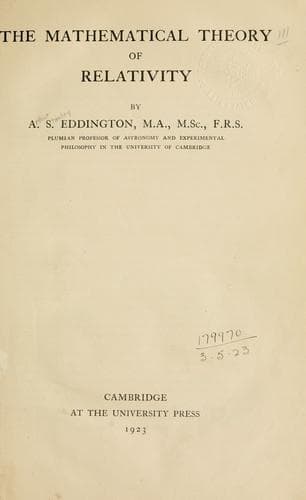
The Mathematical Theory of RelativityEddington, Arthur Stanley, Sir
Science
The Mathematical Theory of Relativity
Eddington, Arthur Stanley, Sir
Relativity (Physics)
If actual matter had no other properties save such as are implied in the
functional form of $G_{\mu}^{\nu} - \frac{1}{2} g_{\mu}^{\nu}G$, it would, I think, be impossible to make measurements
with it. The property which makes it serviceable for measurement is
discontinuity (not necessarily in the strict sense, but discontinuity from the
macroscopic standpoint, i.e.\ atomicity). So far our only attempt to employ
\index{Atomicity}%
the new-found matter for measuring intervals has been in the study of the
dynamics of a particle in \SecRef{56}; we had there to assume that discrete particles
\PageSep{147}
exist and further that they have necessarily a symmetry of field; on this
understanding we have completed the cycle for one of our most important
test-bodies---the moving particle---the geodesic motion of which is used, especially
in astronomy, for comparing intervals. But the theory of the use of
matter for the purpose of measuring intervals will be taken up in a more
general way at the beginning of the next chapter, and it will be seen how
profoundly the existence of the complete cycle has determined that outlook
on the world which we express in our formulation of the laws of mechanics.
It is a feature of our attitude towards nature that we pay great regard to
\index{Energy-tensor of matter!obtained by Hamiltonian differentiation}%
\index{Principle!of least action}%
\index{Stationary action, principle of}%
that which is permanent; and for the same reason the creation of anything
\index{Creation of the physical world}%
in the midst of a region is signalised by us as more worthy of remark than
its entry in the orthodox manner through the boundary. Thus when we
consider how an invariant depends on the variables used to describe the
world, we attach more importance to changes which result in creation than
to changes which merely involve transfer from elsewhere. It is perhaps for
this reason that the Hamiltonian derivative of an invariant gives a quantity
\index{Hamiltonian derivative!creative aspect of}%
of greater significance for us than, for example, the ordinary derivative. The
Hamiltonian derivative has a creative quality, and thus stands out in our
minds as an active agent working in the passive field of space-time. Unless
this idiosyncrasy of our practical outlook is understood, the Hamiltonian
method with its casting away of boundary integrals appears somewhat artificial;
but it is actually the natural method of deriving physical quantities
prominent in our survey of the world, because it is guided by those principles
which have determined their prominence. The particular form of the
Hamiltonian method known as Least Action, in which special search is made
\index{Action, principle of Stationary}%
for Hamiltonian derivatives which vanish, does not appear at present to admit
of any very general application. In any case it seems better adapted to give
neat mathematical formulae than to give physical insight; to grasp the
Public-domain text, read in full here on John Shaqi.
Reviews
Reviews
No reviews yet
Be the first to share your thoughts on this work.
Elsewhere in the archive
Join the Discussion
Join the discussion
Sign in to leave a comment or review.
Sign InorCreate an account