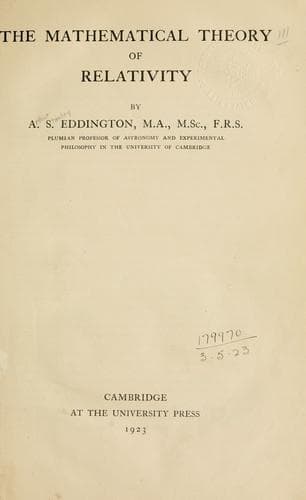
The Mathematical Theory of RelativityEddington, Arthur Stanley, Sir
Science
The Mathematical Theory of Relativity
Eddington, Arthur Stanley, Sir
Relativity (Physics)
This result obtained for five dimensions is perfectly general. From the
manner in which \Eq{(65.4)}~was obtained, it will be seen that each of the six~$z$'s will
make contributions to~$g_{\nu\tau}$ which are simply additive; we have merely to sum
$a_{\mu\nu} a_{\sigma\tau} x_{\mu} x_{\sigma}$ for the six values of~$a_{\mu\nu} a_{\sigma\tau}$ contributed by the six terms~$dz_{r}^{2}$. All the
subsequent steps involve linear equations and the work will hold for six~$z$'s
just as well as for one~$z$. Hence \Eq{(65.72)}~is true in the general case when the
representation requires $10$~dimensions.
Now consider the invariant quadric
\[
(G_{\mu\nu} - \tfrac{1}{2} g_{\mu\nu} G)\, dx_{\mu}\, dx_{\nu} = 3.
\Tag{(65.81)}
\]
Let $\rho_{1}$~be the radius of this quadric in the $x_{1}$~direction, so that $dx_{\mu} = (\rho_{1} , 0, 0, 0)$
is a point on the quadric; the equation gives
\[
(G_{11} - \tfrac{1}{2} g_{11}G) \rho_{1}^{2} = 3,
\]
so that by~\Eq{(65.72)}
\[
G_{(1)} = \frac{6}{\rho_{1}^{2}}.
\Tag{(65.82)}
\]
But for a hypersphere of radius~$R$ of \emph{three} dimensions ($k_{1} = k_{2} = k_{3} = 1/R$;
$k_{4}$~disappears) the Gaussian curvature is~$6/R^{2}$. Hence $\rho_{1}$~is the radius of
spherical curvature of the three-dimensional section of the world perpendicular
to the axis~$x_{1}$.
Now the quadric~\Eq{(65.81)} is invariant, so that the axis~$x_{1}$ may be taken in
any arbitrary direction. Accordingly we see that---
\emph{The radius of the quadric $(G_{\mu\nu} = \tfrac{1}{2} g_{\mu\nu}G)\, dx_{\mu}\, dx_{\nu} = 3$ in any direction is equal
to the radius of spherical curvature of the corresponding three-dimensional
section of the world.}
We call this quadric the \emph{quadric of curvature}.
\index{Quadric of curvature}%
\Section{66.}{Interpretation of Einstein's law of gravitation}
We take the later form of Einstein's law~\Eq{(37.4)}
\[
G_{\mu\nu} = \lambda g_{\mu\nu},
\Tag{(66.1)}
\]
in empty space, $\lambda$~being a universal constant at present unknown but so small
as not to upset the agreement with observation established for the original
form $G_{\mu\nu} = 0$. We at once obtain $G = 4\lambda$, and hence
\[
G_{\mu\nu} - \tfrac{1}{2} g_{\mu\nu} G = -\lambda g_{\mu\nu}.
\]
\PageSep{153}
Substituting in~\Eq{(65.81)} the quadric of curvature becomes
\[
-\lambda g_{\mu\nu}\, dx_{\mu}\, dx_{\nu} = 3,
\]
or
\[
-ds^{2} = 3/\lambda.
\Tag{(66.2)}
\]
That is to say, the quadric of curvature is a sphere of radius~$\Chg{\surd(3/\lambda)}{\sqrt{3/\lambda}}$, and the
radius of curvature in every direction\footnote
{For brevity I use the phrase ``radius of curvature in a direction'' to mean the radius of
spherical curvature of the three-dimensional section of the world at right angles to that direction.
There is no other radius of curvature \emph{associated with a direction} likely to be confused with it.}
and at every point in empty space has
the constant length~$\Chg{\surd(3/\lambda)}{\sqrt{3/\lambda}}$.
Public-domain text, read in full here on John Shaqi.
Reviews
Reviews
No reviews yet
Be the first to share your thoughts on this work.
Elsewhere in the archive
Join the Discussion
Join the discussion
Sign in to leave a comment or review.
Sign InorCreate an account