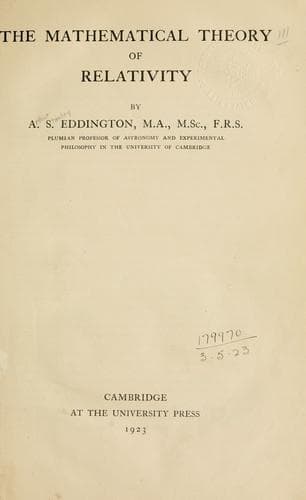
The Mathematical Theory of RelativityEddington, Arthur Stanley, Sir
Science
The Mathematical Theory of Relativity
Eddington, Arthur Stanley, Sir
Relativity (Physics)
The possibility of the existence of an electron in space is a remarkable
phenomenon which we do not yet understand. The details of its structure
must be determined by some unknown set of equations, which apparently
admit of only two discrete solutions, the one giving a negative electron and
the other a positive electron or proton. If we solve these equations to find
\PageSep{154}
the radius of the electron in any direction, the result must necessarily take
the form
\begin{quote}
radius of electron in given direction $=$ numerical constant $\times$ some
function of the conditions in the space into which the electron
was inserted.
\end{quote}
And since the quantity on the left is a directed length, the quantity on the
right must be a directed length. We have just found one directed length
characteristic of the empty space in which the electron was introduced, viz.\
the radius of spherical curvature of a corresponding section of the world.
Presumably by going to third or fourth derivatives of the~$g_{\mu\nu}$ other independent
directed lengths could be constructed; but that seems to involve an unlikely
complication. There is strong ground then for anticipating that the solution
of the unknown equations will be
\begin{quote}
radius of electron in any direction $=$ numerical constant $\times$ radius of
curvature of space-time in that direction.
\end{quote}
This leads at once to the law~\Eq{(66.3)}.
As with the electron, so with the atom and aggregations of atoms forming
the practical units of material structure. Thus we see that Einstein's law of
gravitation is the almost inevitable outcome of the use of material measuring-appliances
for surveying the world, whatever may be the actual laws under
which material structures are adjusted in equilibrium with the empty space
around them.
Imagine first a world in which the curvature, referred to some chosen
(non-material) standard of measurement, was not isotropic. An electron inserted
in this would need to have the same anisotropy in order that it might
obey the same detailed conditions of equilibrium as a symmetrical electron in
an isotropic world. The same anisotropy persists in any material structure
formed of these electrons. Finally when we \emph{measure} the world, i.e.\ make comparisons
with material structures, the anisotropy occurs on both sides of the
comparison and is eliminated. Einstein's law of gravitation expresses the
\index{Einstein's law of gravitation!interpretation of}%
result of this elimination. The symmetry and homogeneity expressed by
Einstein's law is not a property of the external world, but a property of the
operation of measurement.
From this point of view it is inevitable that the constant~$\lambda$ cannot be
zero; so that empty space has a finite radius of curvature relative to familiar
standards. An electron could never decide how large it ought to be unless
there existed some length independent of itself for it to compare itself with.
Public-domain text, read in full here on John Shaqi.
Reviews
Reviews
No reviews yet
Be the first to share your thoughts on this work.
Elsewhere in the archive
Join the Discussion
Join the discussion
Sign in to leave a comment or review.
Sign InorCreate an account