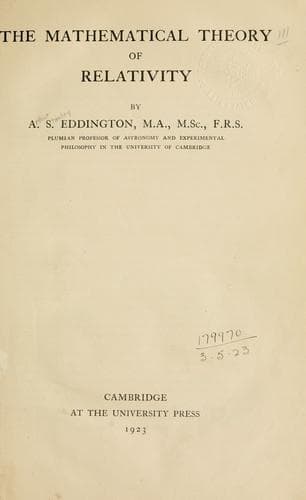
The Mathematical Theory of RelativityEddington, Arthur Stanley, Sir
Science
The Mathematical Theory of Relativity
Eddington, Arthur Stanley, Sir
Relativity (Physics)
We have then to distinguish between Natural Geometry, which is the
single \emph{true} geometry in the sense understood by the physicist, and World
Geometry, which is the pure geometry applicable to a conceptual graphical
representation of all the quantities concerned in physics. We may perhaps go
so far as to say that the World Geometry is intended to be closely descriptive
\index{Geometry, Riemannian!world geometry}%
\index{World geometry}%
of the fundamental relation-structure which underlies the various manifestations
of space, time, matter and electromagnetism; that statement, however,
is rather vague when we come to analyse it. Since the graphical representation
is in any case conventional we cannot say that one method rather than another
is right. Thus the two geometries discussed in Parts I and~II of this chapter
are not to be regarded as contradictory. My reason for introducing the second
treatment is that I find it to be more illuminating and far-reaching, not that
I reject the first representation as inadmissible.
In the following account of Weyl's theory I have not adhered to the author's
\index{Weyl's theory}%
order of development, but have adapted it to the point of view here taken up,
which sometimes differs (though not, I believe, fundamentally) from that which
he adopts. It may be somewhat unfair to present a theory from the wrong
end---as its author might consider; but I trust that my treatment has not
unduly obscured the brilliance of what is unquestionably the greatest advance
in the relativity theory after Einstein's work.
\Section{84.}{Non-integrability of length}
\index{Integrability of parallel displacement!of length and direction}%
\index{Length!non-integrability of}%
\index{Non-integrability of length and direction}%
We have found in \SecRef{33} that the change~$\delta A_{\mu}$ of a vector taken by parallel
displacement round a small circuit is
\begin{align*}
\delta A_{\mu}
&= \tfrac{1}{2} (A_{\mu\nu\sigma} - A_{\mu\sigma\nu})\, dS^{\nu\sigma}\displaybreak[0] \\
&= \tfrac{1}{2} B_{\mu\nu\sigma}^{\epsilon} A_{\epsilon}\, dS^{\nu\sigma}\displaybreak[0] \\
&= \tfrac{1}{2} B_{\mu\nu\sigma\epsilon} A^{\epsilon}\, dS^{\nu\sigma}.
\Tag{(84.1)}\displaybreak[0]
\intertext{Hence}
A^{\mu}\, \delta A_{\mu}
&= \tfrac{1}{2} B_{\mu\nu\sigma\epsilon} A^{\mu} A^{\epsilon}\, dS^{\nu\sigma} = 0,
\end{align*}
since $B_{\mu\nu\sigma\epsilon}$~is antisymmetrical in $\mu$ and~$\epsilon$.
Hence by~\Eq{(26.4)} $\delta A_{\mu}$~is perpendicular to~$A_{\mu}$, and the \emph{length} of the vector~$A_{\mu}$
is unaltered by its parallel displacement round the circuit. It is only the
direction which changes.
Public-domain text, read in full here on John Shaqi.
Reviews
Reviews
No reviews yet
Be the first to share your thoughts on this work.
Elsewhere in the archive
Join the Discussion
Join the discussion
Sign in to leave a comment or review.
Sign InorCreate an account