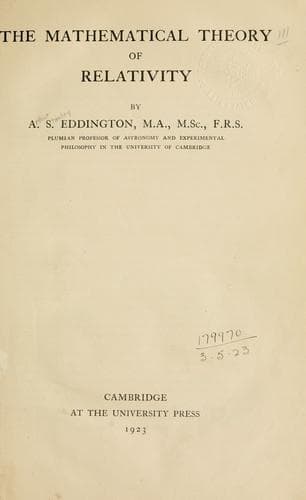
The Mathematical Theory of RelativityEddington, Arthur Stanley, Sir
Science
The Mathematical Theory of Relativity
Eddington, Arthur Stanley, Sir
Relativity (Physics)
Let $A_{\mu}^{\nu}$~be a symmetrical in-tensor; its divergence~\Eq{(51.31)} becomes on
gauge-transformation
\begin{align*}
{A'}_{\mu\nu}^{\nu}
&= \frac{1}{\lambda^{4} \sqrt{-g}}\, \frac{\dd}{\dd x_{\nu}} (A_{\mu}^{\nu} \lambda^{4} \sqrt{-g})
- \tfrac{1}{2} (\lambda^{-2} A^{\alpha\beta})\, \frac{\dd}{\dd x_{\mu}} (\lambda^{2} g_{\alpha\beta}) \\
&= \frac{1}{\sqrt{-g}}\, \frac{\dd}{\dd x_{\nu}} (A_{\mu}^{\nu}\sqrt{-g})
%[** TN: Not broken in the original]
\begin{aligned}[t]
&- \tfrac{1}{2} A^{\alpha\beta}\, \frac{\dd g_{\alpha\beta}}{\dd x_{\mu}}
+ A_{\mu}^{\nu} · \frac{1}{\lambda^{4}}\, \frac{\dd\lambda^{4}}{\dd x_{\nu}} \\
&- \tfrac{1}{2} A^{\alpha\beta} g_{\alpha\beta} · \frac{1}{\lambda^{2}}\, \frac{\dd\lambda^{2}}{\dd x_{\mu}}
\end{aligned} \\
&= A_{\mu\nu}^{\nu} + 4A_{\mu}^{\nu} \phi_{\nu} - A\phi_{\mu}.
\end{align*}
Hence by~\Eq{(85.52)} the quantity
\[
\Star{A}_{\mu\nu}^{\nu} = A_{\mu\nu}^{\nu} - 4A_{\mu}^{\nu} \kappa_{\nu} + A\kappa_{\mu}
\Tag{(86.4)}
\]
is unaltered by any gauge-transformation, and is accordingly an in-vector.
This operation may be called in-covariant differentiation, and the result is
the in-divergence.
The result is modified if $A^{\mu\nu}$~is the in-tensor, so that $A_{\mu}^{\nu}$~is a co-tensor. The
different associated tensors are not equally fundamental in Weyl's geometry,
since only one of them can be an in-tensor.
Unless expressly stated a final suffix will indicate ordinary covariant (not
in-covariant) differentiation.
\PageSep{204}
\Section{87.}{The generalised Riemann-Christoffel tensor}
\index{Riemann-Christoffel tensor!generalisation of}%
Corresponding to~\Eq{(34.4)} we write
\[
\Star{B}_{\mu\nu\sigma}^{\epsilon}
\!=\! -\frac{\dd}{\dd x_{\sigma}} \Star{\{\mu\nu, \epsilon\}}
+ \Star{\{\mu\sigma, \alpha\}} \Star{\{\alpha\nu, \epsilon\}}
+ \frac{\dd}{\dd x_{\nu}} \Star{\{\mu\sigma, \epsilon\}}
- \Star{\{\mu\nu, \alpha\}} \Star{\{\alpha\sigma, \epsilon\}}.
\Tag{(87.1)}
\]
This will be an in-tensor since the starred symbols are all independent of
the gauge; and it will be evident when we reach~\Eq{(87.4)} that the generalisation
has not destroyed the ordinary tensor properties.
Public-domain text, read in full here on John Shaqi.
Reviews
Reviews
No reviews yet
Be the first to share your thoughts on this work.
Elsewhere in the archive
Join the Discussion
Join the discussion
Sign in to leave a comment or review.
Sign InorCreate an account