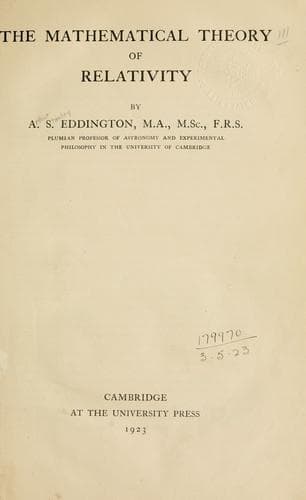
The Mathematical Theory of RelativityEddington, Arthur Stanley, Sir
Science
The Mathematical Theory of Relativity
Eddington, Arthur Stanley, Sir
Relativity (Physics)
Hence interchanging $\nu$ and~$\sigma$, and subtracting, the complete expression is
\begin{multline*}
\Star{B}_{\mu\nu\sigma}^{\epsilon}
= B_{\mu\nu\sigma}^{\epsilon} + g_{\mu}^{\epsilon} \left(\frac{\dd\kappa_{\nu}}{\dd x_{\sigma}} - \frac{\dd\kappa_{\sigma}}{\dd x_{\nu}}\right)
+ (g_{\nu}^{\epsilon} \kappa_{\mu\sigma} - g_{\sigma}^{\epsilon} \kappa_{\mu\nu})
+ (g_{\mu\sigma} \kappa_{\nu}^{\epsilon} - g_{\mu\nu} \kappa_{\sigma}^{\epsilon}) \\
+ (g_{\nu}^{\epsilon} \kappa_{\mu} \kappa_{\sigma} - g_{\sigma}^{\epsilon} \kappa_{\mu} \kappa_{\nu})
+ (g_{\sigma}^{\epsilon} g_{\mu\nu} - g_{\nu}^{\epsilon} g_{\mu\sigma}) \kappa_{\alpha} \kappa^{\alpha}
+ (g_{\mu\sigma} \kappa_{\nu} - g_{\mu\nu} \kappa_{\sigma}) \kappa^{\epsilon}.
\Tag{(87.4)}
\end{multline*}
Next set $\epsilon = \sigma$. We obtain the contracted in-tensor
\begin{multline*}
\Star{G}_{\mu\nu} = G_{\mu\nu} - F_{\mu\nu}
+ (\kappa_{\mu\nu} - 4\kappa_{\mu\nu})
+ (\kappa_{\mu\nu} - g_{\mu\nu} \kappa_{\alpha}^{\alpha})
+ (\kappa_{\mu} \kappa_{\nu} - 4\kappa_{\mu} \kappa_{\nu}) \\
+ (4g_{\mu\nu} - g_{\mu\nu}) \kappa_{\alpha} \kappa^{\alpha}
+ (\kappa_{\mu} \kappa_{\nu} - g_{\mu\nu} \kappa_{\alpha} \kappa^{\alpha}) \\
= G_{\mu\nu} - 2F_{\mu\nu} - (\kappa_{\mu\nu} + \kappa_{\nu\mu})
- g_{\mu\nu} \kappa_{\alpha}^{\alpha}
- 2\kappa_{\mu} \kappa_{\nu}
+ 2g_{\mu\nu} \kappa_{\alpha}^{\alpha}.\footnotemark
\Tag{(87.5)}
\end{multline*}
\PageSep{205}
Finally multiply by~$g^{\mu\nu}$. We obtain the co-invariant
\footnotetext{The unit of~$\kappa_{\mu}$ is arbitrary; and in the generalised theory in Part~II the $\kappa_{\mu}$ there employed
corresponds to twice the $\kappa_{\mu}$ of these formulae. This must be borne in mind in comparing, for
example, \Eq{(87.5)} and~\Eq{(94.3)}.}%
\[
\Star{G} = G - 6\kappa_{\alpha}^{\alpha} + 6\kappa_{\alpha} \kappa^{\alpha}.
\Tag{(87.6)}
\]
The multiplication by~$g^{\mu\nu}$ reintroduces the unit of gauge, so that $\Star{G}$~becomes
multiplied by~$\lambda^{-2}$ when the gauge is transformed.
If the suffix~$\epsilon$ is lowered in~\Eq{(87.4)} the only part of~$\Star{B}_{\mu\nu\sigma\epsilon}$ which is symmetrical
in $\mu$~and $\epsilon$ is $g_{\mu\nu} (\dd\kappa_{\nu}/\dd x_{\sigma} - \dd\kappa_{\sigma}/\dd x_{\nu}) = g_{\mu\epsilon} F_{\nu\sigma}$, which agrees with the
condition~\Item{(a)} of Weyl's geometry (\SecRef{84}).
\Section{88.}{The in-invariants of a region}
\index{In-invariants}%
There are no functions of the~$g_{\mu\nu}$ and~$\kappa_{\mu}$ at a point which are in-invariants;
but functions which are in-invariant-densities may be found as
follows---
Public-domain text, read in full here on John Shaqi.
Reviews
Reviews
No reviews yet
Be the first to share your thoughts on this work.
Elsewhere in the archive
Join the Discussion
Join the discussion
Sign in to leave a comment or review.
Sign InorCreate an account