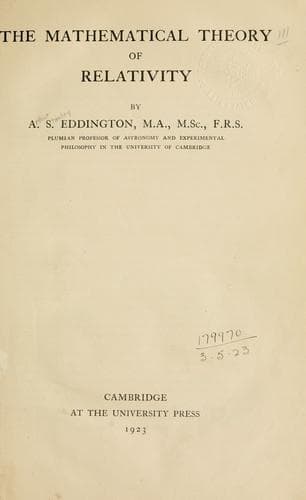
The Mathematical Theory of RelativityEddington, Arthur Stanley, Sir
Science
The Mathematical Theory of Relativity
Eddington, Arthur Stanley, Sir
Relativity (Physics)
Let a displacement~$A^{\mu}$ be carried by parallel displacement round a small
circuit~$C$. The condition for parallel displacement is by~\Eq{(91.1)}
\[
\frac{\dd A^{\mu}}{\dd x_{\nu}} = -\Gamma_{\nu\alpha}^{\mu} A^{\alpha}.
\Tag{(92.1)}
\]
Hence the difference of the initial and final values is
\begin{align*}
\delta A^{\mu}
&= \int_{C} \frac{\dd A^{\mu}}{\dd x_{\nu}}\, dx_{\nu} \\
&= -\int_{C} \Gamma_{\nu\alpha}^{\mu} A^{\alpha}\, dx_{\nu} \\
&= \frac{1}{2} \iint \left\{
\frac{\dd}{\dd x_{\sigma}} (\Gamma_{\nu\alpha}^{\mu} A^{\alpha})
- \frac{\dd}{\dd x_{\nu}} (\Gamma_{\sigma\alpha}^{\mu} A^{\alpha})\right\} dS^{\nu\sigma}
\end{align*}
by Stokes's theorem~\Eq{(32.3)}.
\index{Stokes's theorem!application of}%
The integrand is equal to
\begin{align*}
&\phantom{{}={}} A^{\alpha} \left(\frac{\dd}{\dd x_{\sigma}} \Gamma_{\nu\alpha}^{\mu}
- \frac{\dd}{\dd x_{\nu}} \Gamma_{\sigma\alpha}^{\mu}\right)
+ \Gamma_{\nu\alpha}^{\mu}\, \frac{\dd A^{\alpha}}{\dd x_{\sigma}}
- \Gamma_{\sigma\alpha}^{\mu}\, \frac{\dd A^{\alpha}}{\dd x_{\nu}} \\
&= A^{\epsilon} \left(\frac{\dd}{\dd x_{\sigma}} \Gamma_{\nu\epsilon}^{\mu}
- \frac{\dd}{\dd x_{\nu}} \Gamma_{\sigma\epsilon}^{\mu}\right)
- \Gamma_{\nu\alpha}^{\mu} \Gamma_{\sigma\epsilon}^{\alpha} A^{\epsilon}
+ \Gamma_{\sigma\alpha}^{\mu} \Gamma_{\nu\epsilon}^{\alpha} A^{\epsilon}
\quad\text{by~\Eq{(92.1)}} \\
&= -\Star{B}_{\epsilon\nu\sigma}^{\mu} A^{\epsilon},
\end{align*}
where
\[
\Star{B}_{\epsilon\nu\sigma}^{\mu}
= -\frac{\dd}{\dd x_{\sigma}} \Gamma_{\nu\epsilon}^{\mu}
+ \frac{\dd}{\dd x_{\nu}} \Gamma_{\sigma\epsilon}^{\mu}
+ \Gamma_{\nu\alpha}^{\mu} \Gamma_{\sigma\epsilon}^{\alpha}
- \Gamma_{\sigma\alpha}^{\mu} \Gamma_{\nu\epsilon}^{\alpha}.
\Tag{(92.2)}
\]
\PageSep{215}
Hence
\[
\delta A^{\mu} = -\frac{1}{2} \iint \Star{B}_{\epsilon\nu\sigma}^{\mu} A^{\epsilon}\, dS^{\nu\sigma}.
\Tag{(92.31)}
\]
As in \SecRef{33} the formula applies only to infinitesimal circuits. In evaluating
the integrand we assumed that $A^{\alpha}$~satisfies the condition of parallel displacement~\Eq{(92.1)}
not only on the boundary but at all points within the circuit. No
single value of~$A^{\alpha}$ can satisfy this, since if it holds for one circuit of displacement
it will not hold for a second. But the discrepancies are of order proportional
to~$dS^{\nu\sigma}$, and another factor~$dS^{\nu\sigma}$ occurs in the integration; hence \Eq{(92.31)}~is
true when the square of the area of the circuit can be neglected.
Public-domain text, read in full here on John Shaqi.
Reviews
Reviews
No reviews yet
Be the first to share your thoughts on this work.
Elsewhere in the archive
Join the Discussion
Join the discussion
Sign in to leave a comment or review.
Sign InorCreate an account