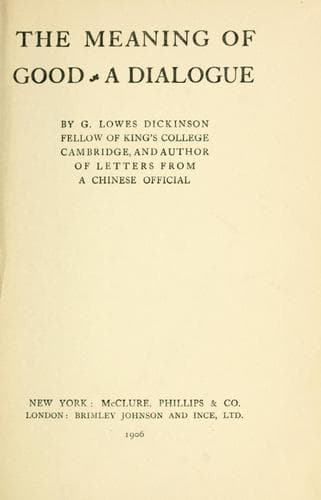
The Meaning of Good—A DialogueDickinson, G. Lowes (Goldsworthy Lowes)
Philosophy
The Meaning of Good—A Dialogue
Dickinson, G. Lowes (Goldsworthy Lowes)
Good and evil
"Very well; I will do my best. Let us look then at life just as it is.
Here we find ourselves involved with one another in the most complex
relations--economic, political, social, domestic, and the rest; and
about and in these relations centres the interest of our life,
whether it be pleasurable or painful, empty or full, or whatever its
character. Among these relations some few perhaps--or, it may be,
even none--realize for a longer or shorter time, with more or less
completeness, that ultimate identity in diversity, that 'me in thee'
which we call love; the rest comprise various degrees of attraction
and repulsion, hatred, contempt, indifference, toleration, respect,
sympathy, and so on; and all together, always changing, dissolving,
and combining anew, weave about us, as they cross and intertwine, the
shifting, restless web we call life. Now these relations are an effect
and result of the pursuit of Good; but they are never the final goal
of that pursuit. The goal, I think, would be a perfect union of all
with all; and is not attained by anything that falls short of this,
whether the defect be in depth or In extent. And that is how it is
that love itself, even in its richer phases, and still more in those
which are merely light and sensual, though, as I think, through it
alone can we form our truest conception of Good, yet, as we have it,
never is the Good, even if it appear to be so for the moment; for
those who seek Good, I believe, will never feel that they have found
it merely in union with one other person. For what love gains in
intension it is apt to lose in extension; so that in practice it may
even come to frustrate the very end it seeks, limiting instead of
expanding, narrowing just in proportion as it deepens, and, by causing
the disruption of all other ties, impoverishing the natures it should
have enriched. Or don't you think that this happens sometimes, for
instance in married life?"
"I do indeed."
"And, on the other hand," I continued, "it may very well be that one
who passes through life without attaining the fruition of love,
yet with his gaze always set upon it, in and through many other
connections, may yet come closer to the end of his seeking than one
who, having known love, has sunk to rest in it then and there, as
though he had come already to his journey's end, when really he has
only reached an inn upon the road. So that I am far from thinking, as
you pretended to suppose, that the boy and girl on the village green
realize then and there the consummation of the world."
"Still," he objected, "I do not see, in the scheme you put forward,
what place is left for the common business of life--for the things
which really do, for the most part, occupy and possess men's minds,
and the more, in my opinion, the greater their force and capacity."
"You mean, I suppose, war and politics, and such things as that?
"Yes, and generally all that one calls business."
Public-domain text, read in full here on John Shaqi.
Reviews
Reviews
No reviews yet
Be the first to share your thoughts on this work.
Elsewhere in the archive
Join the Discussion
Join the discussion
Sign in to leave a comment or review.
Sign InorCreate an account