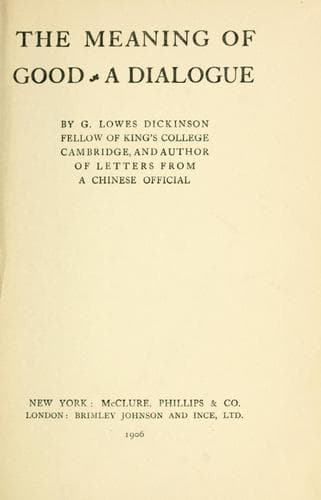
The Meaning of Good—A DialogueDickinson, G. Lowes (Goldsworthy Lowes)
Philosophy
The Meaning of Good—A Dialogue
Dickinson, G. Lowes (Goldsworthy Lowes)
Good and evil
"Just this," I replied, "that up to a certain time of life all the
Good that we get we take to be prophetic of more Good to come. What
we actually realize we value less for itself than for something else
which it promises. The moments of good experience we expand till they
fill all infinity; the intervening tracts of indifferent or bad we
simply forget or ignore. Life is good, we say, because the universe
is good; and this goodness we expect to grasp in its entirety, not
to-day, perhaps, nor to-morrow, but at least the day after. And so,
like the proverbial ass, we are lured on by a wisp of hay. But being,
at bottom, intelligent brutes, we begin, in time, to reflect; we put
back our ears, and plant our feet stiff and rigid where we stand, and
refuse to budge an inch till we have some further information as to
the meaning of the journey into which we are being enticed. That,
at least, is the point that has been reached by this ass who is now
addressing you. I want to know something more about that bundle of
hay; and that is why I am interested in the question of personal
immortality."
"Which means--to drop the metaphor----?"
"Which means, that I have come to realize that I am not likely to get
more Good out of life than I have already had, and that I may very
likely get less; or if more in some respects, then less in others.
For, in the first place, the world, as it seems, is just as much bad
as good, and whether Good or Bad predominate I cannot say. And in the
second place, even of what Good there is--and I do not under-estimate
its worth--it is but an infinitesimal portion that I am capable of
realizing, so limited am I by temperament and circumstance, so
bound by the errors and illusions of the past, so hampered by the
disabilities crowding in from the future. For though, as I think, the
older I get the more clearly I recognize what is good, and the more I
learn to value and to perceive it, yet at the same time the less do I
become capable of making it my own, and must in the nature of things
become less and less so, in so far at least as Goods other than those
of the intellect are concerned. And this is a position which seems to
be involved in the mere fact of age and death frankly seen from
the naturalistic point of view; and so it has always been felt
and expressed from the time of the Greeks onwards, and not least
effectively, perhaps, by Browning in his 'Cleon'--you remember the
passage:
Public-domain text, read in full here on John Shaqi.
Reviews
Reviews
No reviews yet
Be the first to share your thoughts on this work.
Elsewhere in the archive
Join the Discussion
Join the discussion
Sign in to leave a comment or review.
Sign InorCreate an account