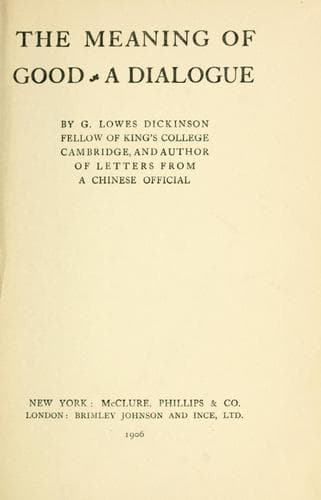
The Meaning of Good—A DialogueDickinson, G. Lowes (Goldsworthy Lowes)
Philosophy
The Meaning of Good—A Dialogue
Dickinson, G. Lowes (Goldsworthy Lowes)
Good and evil
"I am ready to admit," I replied, "that there are people to whom it
seems to be so, but I doubt whether they are very numerous, among
those, I mean, who have reflected on the subject, and whose opinions
alone we need consider. I, at any rate, have commonly found in talking
to people about death--supposing, which is unusual, that they are
willing to talk about it at all--that they adopt one of two views,
either of which presupposes the worthlessness of life, if life, as we
know it, be indeed all"
"What views do you mean?"
"Why, either they believe that death means annihilation, and rejoice
in the prospect as a deliverance from an intolerable evil; or they
hold that there is a life beyond, and that they will find there the
reason and justification for existence which they have never been able
to discover here."
"You forget, surely," said Wilson, "a third point of view, which I
should have thought was as common as either of the others,--that of
those who believe in a life after death, but look forward to it with
inexpressible fear of the possible evils which it may contain."
"True," I said, "but such fear, I suppose, is a reflex of actual
experience, and implies, does it not, a vivid sense of the evils of
existence as we know it? So that these people, too, I should maintain,
have not really found life satisfactory, or they would look forward
with hope rather than fear to the possibility of Its continuance."
"But in their case, at any rate, the hypothesis of personal
immortality is an aggravation, not a remedy, of the evil."
"No doubt; but I have been assuming throughout that the hypothesis
involves the realization of that Good which, without it, we recognize
to be unattainable; and it is only in that sense, and from that point
of view, that I have introduced it."
"Well," he persisted, "considering how improbable the hypothesis is,
I should be very loth to admit that it is one which it is practically
necessary to adopt. And I still maintain that most people do not
require it--ordinary simple people, I mean, who do their work and make
no fuss about it."
"Perhaps not," I replied, "for it is characteristic of such people
to make no hypothesis at all, but to adopt for the moment any view
suggested by the state of their spirits. But I believe that if ever
you can get a man, no matter how plain and unsophisticated, to reflect
fairly upon his own experience, and to look impartially at the facts
all round, abstracting from all bias of habit and mood and prejudice,
he will admit that if it be true that the individual is extinguished
at death, together with all his possibilities of realizing Good,
then life cannot rationally be judged to be worth the living, however
imperatively we may be compelled to continue to live it."
"But it Is just that imperative compulsion," cried Parry, "on which I
rely! That seems to me the justification of life--the fact that we are
forced to live! I trust that instinct more than all the inclination in
the world!"
Public-domain text, read in full here on John Shaqi.
Reviews
Reviews
No reviews yet
Be the first to share your thoughts on this work.
Elsewhere in the archive
Join the Discussion
Join the discussion
Sign in to leave a comment or review.
Sign InorCreate an account