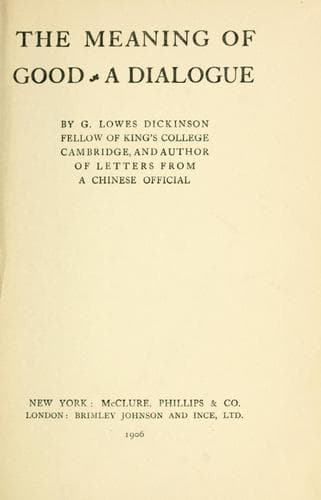
The Meaning of Good—A DialogueDickinson, G. Lowes (Goldsworthy Lowes)
Philosophy
The Meaning of Good—A Dialogue
Dickinson, G. Lowes (Goldsworthy Lowes)
Good and evil
But Wilson entered a vigorous protest, and for a time there was a
babel of argument and declamation, from which no clear line of thought
disengaged itself. Dennis, however, in his persistent way, had been
revolving in his mind what I had said, and at the first opportunity he
turned to me with the remark, "There's one point in your position that
I can't understand. Do you mean to say that it is our seeking that
determines the Good, or the Good that determines our seeking."
"Really," I said, "I don't know. I should say both are true. We, in
the process of our seeking, affirm what we find to be good, and
in that sense determine for ourselves what for us was previously
indeterminate; but, on the other hand, our determination is not mere
caprice; it is determination of Good, which we must therefore suppose
somehow or other to 'be' before we discern it."
"But then, in what sense _is_ it?"
"That is what it is so hard to say. Perhaps it is the law of our
seeking, the creative and urging principle of the world, striving
through us to realize itself, and recognized by us in that effort and
strain."
"Then your hypothesis is that Good has to be brought about, even while
you admit that in some sense it is?"
"Yes, it exists partially, and it ought to come to exist completely."
"Well now, that is exactly what seems to me absurd. If Good is at all
it is eternal and complete."
"But then, I ask in my turn, in what sense _is_ it?"
"In the only sense that anything really is. The rest is nothing but
appearance."
"What we call Evil, you mean, is nothing but appearance."
"Yes."
"You think, in fact, with the poet, that 'all that is, is good'?"
"Yes," he replied, "all that really is."
"Ah!" I said, "but in that 'really' lies the crux of the matter. Take,
for instance, a simple fact of our own experience--pain. Would you
say, perhaps, that pain is good?"
"No," he replied, "not as it appears to us; but as it really is."
"As it really is to whom, or in whom?"
"To the Absolute, we will say; to God, if you like."
"Well, but what is the relation of the pain as it is in God to the
pain that appears to us?"
"I don't pretend to know," he said, "but that is hardly the point. The
point is, that it is only in connection with what is in God that the
word Good has any real meaning. Appearance is neither good nor bad; it
is simply not real."
"But," cried Audubon, interrupting in a kind of passion, "It is in
appearance that we live and move and have our being. What is the use
of saying that appearance is neither good nor bad, when we are feeling
it as the one or the other every moment of our lives? And as to the
Good that is in God, who knows or cares about it? What consolation is
it to me when I am suffering from the toothache, to be told that God
is enjoying the pain that tortures me? It is simply absurd to call
God's Good good at all, unless it has some kind of relation to our
Good."
Public-domain text, read in full here on John Shaqi.
Reviews
Reviews
No reviews yet
Be the first to share your thoughts on this work.
Join the Discussion
Join the discussion
Sign in to leave a comment or review.
Sign InorCreate an account