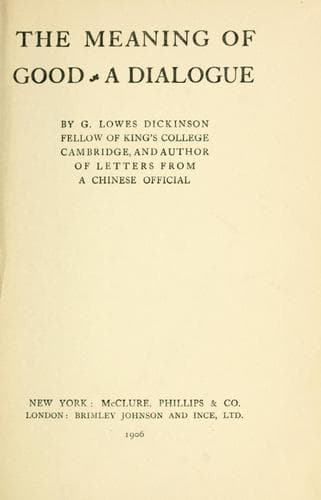
The Meaning of Good—A DialogueDickinson, G. Lowes (Goldsworthy Lowes)
Philosophy
The Meaning of Good—A Dialogue
Dickinson, G. Lowes (Goldsworthy Lowes)
Good and evil
"Well," said Dennis, "as to that, I can only say that, in my opinion,
it is nothing but our weakness that leads us to take such a view. When
I am really at my best, when my intellect and imagination are working
freely, and the humours and passions of the flesh are laid to rest, I
seem to see, with a kind of direct intuition, that the world, just as
it is, is good, and that it is only the confusion and obscurity due to
imperfect vision that makes us call it defective and wish to alter it
for the better. When I perceive Truth at all, I perceive that it is
also Good; and I cannot then distinguish between what is, and what
ought to be."
"Really," cried Audubon, "really? Well, that I cannot understand."
"I hardly know how to make it clear," he replied, "unless it were by
a concrete example. I find that when I think out any particular aspect
of things, so far, that is to say, as I can think it out at all, all
the parts and details fall into such perfect order and arrangement
that it becomes impossible for me any longer to desire that anything
should be other than it is. And that, even in the regions where at
other times I am most prone to discover error and defect. You know,
for instance, that I am something of an economist?"
"What are you not?" I said. "If you sin, it is not from lack of
light!"
"Well," he continued, "there is, I suppose, no department of affairs
which one is more inclined to criticise than this. And yet the more
one investigates the more one discovers, even here, the harmony
and necessity that pervade the whole universe. The ebb and flow of
business from this trade or country to that, the rise and fall of
wages, or of the rate of interest, the pouring of capital into or
out of one industry or another, the varying relations of imports
to exports, the periods of depression and recovery, and in close
connection with all this the ever-changing conditions of the lives of
countless workmen throughout the world, their well-being or ill-being,
it may be their very life and death, together with the whole fate
of future generations in health, capacity, opportunity, and the
like,--all this complexus of things, so chaotic and unintelligible at
the first view, so full, as we say, of iniquity, injustice, and the
like, falls, as we penetrate further, into one vast and harmonious
system, so inspiring to the imagination, so inevitable to the
understanding, that our objections and cavillings, ethical, æsthetic,
or what you will, simply vanish away at the clearer vision, or, if
they persist, persist as mere irrelevant illusions; while we
abandon ourselves to the contemplation of the whole, as of some
world-symphony, whose dissonances, no less than its concords, are
taken up and resolved in the irresistible march and progress, the
ocean-flooding of the Whole. You will think," he continued, "that I am
absurdly rhapsodical over what, after all, is matter prosaic enough;
but what I wanted to suggest was that it is Reality so conceived that
Public-domain text, read in full here on John Shaqi.
Reviews
Reviews
No reviews yet
Be the first to share your thoughts on this work.
Join the Discussion
Join the discussion
Sign in to leave a comment or review.
Sign InorCreate an account