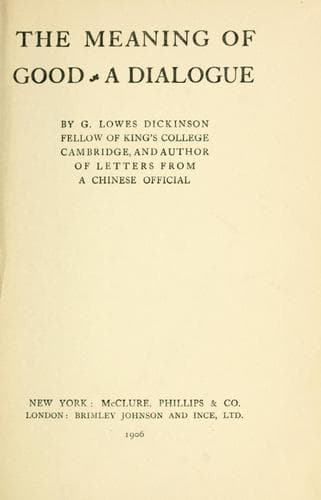
The Meaning of Good—A DialogueDickinson, G. Lowes (Goldsworthy Lowes)
Philosophy
The Meaning of Good—A Dialogue
Dickinson, G. Lowes (Goldsworthy Lowes)
Good and evil
"No," he replied, "I would not put it so. Some meaning, I apprehend,
there must be in time and change, and some meaning also in our
efforts, though not, I believe, the meaning which we imagine. The
divine life, as I conceive it, is a process; only a process that
is somehow eternal, circular, so to speak, not rectilinear, much as
Milton appears to imagine it when he describes the blessed spirits
'progressing the dateless and irrevoluble circle of eternity'; and
of this eternal process our activity, which we suppose to be moving
towards an end, is somehow or other an essential element. So that,
in this way, it is necessary and right that we should strive after
ideals; only, when we are thinking philosophically, we ought to make
clear to ourselves that in truth the Ideal is eternally fulfilled, its
fulfilment consisting precisely In that process which we are apt to
regard as a mere means to its realization. This, as Hegel has it, is
the 'cunning' of the Absolute Reason, which deludes us into the
belief that there is a purpose to be attained, and by the help of that
delusion preserves that energy of action which all the time is really
itself the End."
I looked up at him as he finished, to see whether he was quite
serious; and as he appeared to be so, and as Leslie still kept
silence, I took up the argument as follows.
"I understand," I said, "in a sort of way what you mean; but still the
same difficulty recurs which Audubon has already put forward. On
your hypothesis there seems to be an impassable gulf between God's
conception of Good and ours. To God, as it seems, the world is
eternally good; and in its goodness is included that illusion by which
it appears to us so bad, that we are continually employed in trying to
make it better. The maintenance of this illusion is essential to the
nature of the world; to us, evil always must appear. But, as we know
by experience, the evil that _appears_ is just as terrible and just
as hateful as it would be if it really _were_. A toothache, as Audubon
put it, is no less a pain to us because it is a pleasure to God. We
cannot, if we would, adopt His point of view; and clearly it would
be impious to try, since we should be endeavouring to defeat His
ingenious plan to keep the world going by hoodwinking us. We therefore
are chained and bound to the whirling wheel of appearance; to us what
seems good is good, and what seems bad, bad; and your contention that
all existence is somehow eternally good is for us simply irrelevant;
it belongs to the point of view of God to which we have no access."
"Yes," cried Audubon, "and what a God to call God at all! Why not
just as much the devil? What are we to think of the Being who is
responsible for a world of whose economy our evil is not merely
an accident, a mistake, but positively an essential, inseparable
condition!"
Public-domain text, read in full here on John Shaqi.
Reviews
Reviews
No reviews yet
Be the first to share your thoughts on this work.
Elsewhere in the archive
Join the Discussion
Join the discussion
Sign in to leave a comment or review.
Sign InorCreate an account