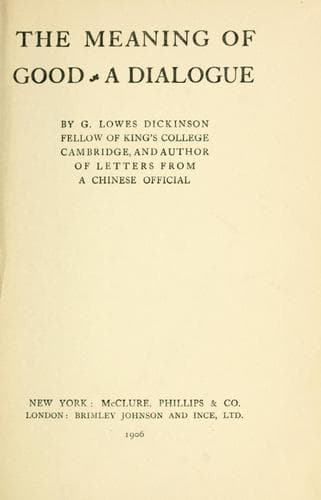
The Meaning of Good—A DialogueDickinson, G. Lowes (Goldsworthy Lowes)
Philosophy
The Meaning of Good—A Dialogue
Dickinson, G. Lowes (Goldsworthy Lowes)
Good and evil
appeals to me at once as Truth and as Good. This partial vision of
mine in the economic sphere is a kind of type of the way in which
I conceive the Absolute. I conceive Him to be a Being necessary and
therefore perfect; a Being in face of whom our own incoherent and
tentative criticisms, our complaints that this or that should, if only
it could, be otherwise, our regrets, desires, aspirations, and
the like, shew but as so many testimonies to our own essential
imperfection, weaknesses to be surmounted, rather than signs of worth
to stamp us, as we vainly boast, the elect of creation."
He finished; and I half expected that Leslie would intervene, since
I saw, as I thought, many weak points in the position. But he kept
silence, impressed, perhaps, by that idea of the Perfect and Eternal
which has a natural home in the minds of the generous and the young.
So I began myself rather tentatively:
"I think," I said, "I understand the position you wish to indicate;
and so stated, in general terms, no doubt it is attractive. It is when
we endeavour to work it out in detail that the difficulties appear.
The position, as I understand it, is, that, from the point of view of
the Absolute, what we call Evil and what we call Good simply have
no existence. Good and Evil, in our sense, are mere appearances; and
Good, in the absolute sense, is identical with the Absolute or with
God?"
"Yes," he said, "that is my notion."
"And so, for example, to apply the idea in detail, in the region which
you yourself selected, all that we regret, or hate, or fear in our
social system--poverty, disease, starvation and the rest--is not
really evil at all, does not in fact exist, but is merely what appears
to us? There is, in fact, no social evil?"
"No," he replied, "in the sense I have explained there is none."
"Well then," I continued, "how is it with all our social and other
ideals? Our desire to make our own lives and other people's lives
happier? Our efforts to subdue nature, to conquer disease, to
introduce order and harmony where there appears to be discord and
confusion? How is it with those finer and less directly practical
impulses by which you yourself are mainly pre-occupied--the quest
of knowledge or of beauty for their own sake, the mere putting of
ourselves into right relations with the universe, apart from any
attempt to modify it? Are all these desires and activities mere
illusions of ours, or worse than illusions, errors and even vices,
impious misapprehensions of the absolutely Good, frivolous attempts to
adapt the Perfect to our own imperfections?"
Public-domain text, read in full here on John Shaqi.
Reviews
Reviews
No reviews yet
Be the first to share your thoughts on this work.
Join the Discussion
Join the discussion
Sign in to leave a comment or review.
Sign InorCreate an account