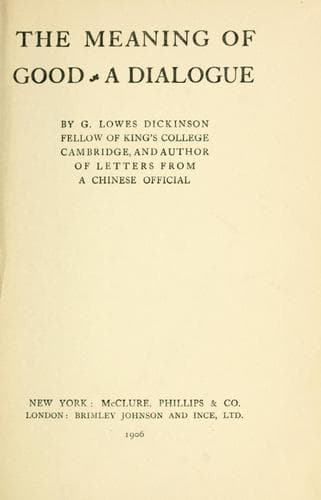
The Meaning of Good—A DialogueDickinson, G. Lowes (Goldsworthy Lowes)
Philosophy
The Meaning of Good—A Dialogue
Dickinson, G. Lowes (Goldsworthy Lowes)
Good and evil
"I am not sure about that. I doubt whether it is true that experience
involves knowledge and _vice versa_. It is, indeed, to my mind,
part of the irony of life, that we know so much which we can never
experience, and experience so much which we can never know."
"I don't follow that," said Bartlett, "but of one thing I am sure,
that you will never get rid of evil by calling it illusion."
"No," Dennis conceded, "you will never of course get rid of it, in the
sense you mean, by that, or indeed, in my opinion, by any other means.
But we were discussing not what we are to do with evil, but how we are
to conceive it."
"But," he objected, "if you begin by conceiving it as illusion, you
will never do anything with it at all."
"Perhaps not, but I am not sure that that is my business."
"At any rate, Dennis," I interposed, "you will, I expect, admit, that
for us, while we live in the region of what you call 'Appearance,'
Evil is at least as pressing and as obvious as Good."
"Yes," he said, "I am ready to admit that."
"And," I continued, "for my part I agree with Bartlett and with
Leslie, that it is Appearance with which we are concerned. What I have
been contending for throughout, is that in the world in which we live
(whether we are to call it Reality or Appearance), Evil and Good are
the really dominating facts; and that we cannot dismiss them from our
consideration either on the ground that we know nothing of them (as
Ellis was inclined to maintain) or on the ground that we know all
about them (as Parry and Wilson seemed to think). On the contrary, it
is, I believe, our main business to find out about them; and that
we can find out about them is with me an article of faith, and so, I
believe, it is with most people, whether or no they are aware of it or
are ready to admit it."
Dennis was preparing to reply, when Ellis reappeared to summon us to
lunch. We followed him in gladly enough, for it was past our usual
hour and we were hungry; and the conversation naturally taking a
lighter turn, I have nothing further to record until we reassembled in
the afternoon.
BOOK II.
When we reassembled for coffee on the loggia after lunch, I did not
suppose we should continue the morning's discussion. The conversation
had been turning mostly on climbing, and other such topics, and
finally had died away into a long silence, which, for my own part, I
felt no particular inclination to break. We had let down an awning to
shelter us from the sun, where it began to shine in upon us, so that
it was still cool and pleasant where we sat; and so delightful did I
feel the situation to be, that I was almost vexed to be challenged to
renew our interrupted debate. The challenge, rather to my surprise,
came from Audubon, who suddenly said to me, _à propos_ of nothing, in
a tone at once ironic and genial:
"Well, I thought you talked very well this morning."
"Really!" I rejoined, "I imagined you were thinking it all great
nonsense."
Public-domain text, read in full here on John Shaqi.
Reviews
Reviews
No reviews yet
Be the first to share your thoughts on this work.
Elsewhere in the archive
Join the Discussion
Join the discussion
Sign in to leave a comment or review.
Sign InorCreate an account