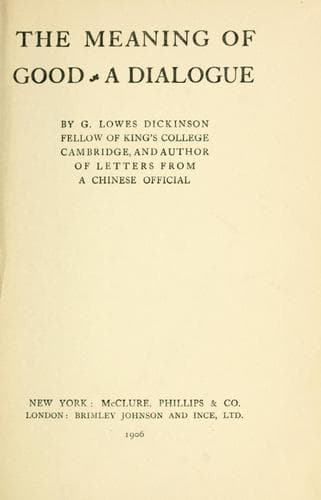
The Meaning of Good—A DialogueDickinson, G. Lowes (Goldsworthy Lowes)
Philosophy
The Meaning of Good—A Dialogue
Dickinson, G. Lowes (Goldsworthy Lowes)
Good and evil
"So no doubt it was," he replied; "still, it amused me to hear you."
"I am glad of that, at any rate; I was afraid perhaps you were bored."
"Not at all. Of course, I couldn't fail to see that you weren't
arriving anywhere. But that I never expected. In fact, what amuses me
most about you is, the way in which you continue to hope that you're
going to get at some result."
"But didn't we?"
"I don't see that you did. You showed, or tried to show, that we must
believe in Good; but you made no attempt to discover what Good is."
"No," I admitted; "that, of course, is much more difficult."
"Exactly; but it is the only point of importance."
"Well," I said, "perhaps if we were to try, we should find that we can
come to some agreement even about that."
"I don't believe it."
"But why not?"
"Because people are so radically different, that there is no common
ground to build upon."
"But is the difference really so radical as all that?"
"Yes," he said, "I think so. At any rate, the proof of the pudding
is in the eating, and I make you an offer. Here are eight of us, all
Englishmen, all contemporaries, all brought up more or less in the
same way. And I venture to say that, if you will raise the question,
you won't find, even among ourselves, with all the chances in your
favour, any substantial agreement about what we think good."
This direct challenge was rather alarming. I didn't feel that I could
refuse to take it up, but I was anxious to guard myself against the
consequences of failure. So I began, with some hesitation, "You must
remember that I have never maintained that at any given moment any
given set of people will be found to be in agreement on all points.
All I ventured to suggest was, that instead of our all being made, as
you contend, radically different, we have, underneath our differences,
a common nature, capable of judging, and judging truly, about Good,
though only on the basis of actual experience of Good. And on this
view I shall, of course, expect to find differences of opinion,
corresponding to differences of experience, even among people as much
alike as ourselves; only I shall not expect the differences to be
finally irreconcilable, but that we shall be able to supplement and
elucidate one another's conclusions by bringing to bear each his own
experience upon that of the rest."
"Well," he said, "we shall see. I have invited you to make the
experiment."
"I am willing," I replied, "if it is agreeable to the others. Only I
must ask you to understand from the beginning precisely what it is I
am trying to do. I shall be merely describing to you what I have
been able to perceive, with such experience as I have had, in this
difficult matter; and you will judge, all of you, whether or no, and
to what extent, your perceptions coincide with mine, the object being
simply to clear up these perceptions of ours, if we can; to define
somehow, as it were, what we have seen, in the hope of coming to see
something more."
Public-domain text, read in full here on John Shaqi.
Reviews
Reviews
No reviews yet
Be the first to share your thoughts on this work.
Elsewhere in the archive
Join the Discussion
Join the discussion
Sign in to leave a comment or review.
Sign InorCreate an account