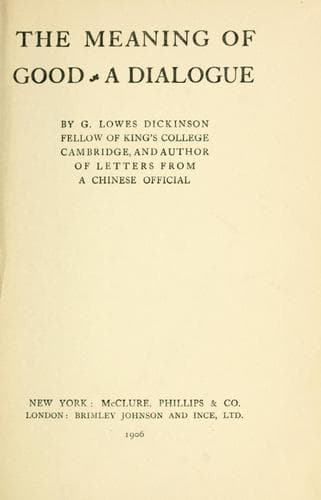
The Meaning of Good—A DialogueDickinson, G. Lowes (Goldsworthy Lowes)
Philosophy
The Meaning of Good—A Dialogue
Dickinson, G. Lowes (Goldsworthy Lowes)
Good and evil
"In the sense that it is its function to maintain and perfect the
species."
"But is that the function of the community?"
"If it is not, it ought to be; and to a great extent it is. If you
look at the social mechanism, not with the eyes of a mere historian,
who usually sees nothing, but with those of a biologist and man of
science, intent upon essentials, you will find that it is nothing but
an elaborate apparatus of selection, natural or artificial, as you
like to call it. First, there is the struggle of races, which may be
traced not only in war and conquest, but more insidiously under the
guise of peace, so that, for example, at this day you may witness
throughout Europe the gradual extinction of the long-headed fair by
the round-headed dark stock. Then there is the struggle of nation with
nation, resulting in the gradual elimination of the weaker--that, of
course, is obvious enough; but what is not always so clearly seen is
the not less certain fact, that within the limits of each society the
same process is everywhere at work. To pass over the economic struggle
for existence, of which we are perhaps sufficiently aware, what else
is our system of examinations but a mechanism of selection, whereby it
is determined that certain persons only shall have access to certain
professions? What else is the convention whereby marriages are
confined to people of the same class, thus securing the perpetuation
of certain types, and especially of the better-gifted and
better-disposed? Turn where we may we find the same phenomenon.
Society is a machine for sifting out the various elements of the race,
combining the like, disparting the unlike, bringing some to the top,
others to the bottom, preserving these, eliminating those, indifferent
to the fate, good or bad, of the individuals it controls, but
envisaging always the well-being of the Whole."
"But," I objected, "is it so certain that it is well-being that is
kept in view? Do you not recognize a process of deterioration as well
as of improvement? You mentioned, for instance, that the long-headed
fair race, is giving place to what I understand is regarded as an
inferior type."
"No doubt," he admitted, "there are periods of decline. Still, on the
whole, the movement is an upward one."
"Well," I replied, "that, after all, is not the question we are at
present discussing. Your main point is, that when we speak of Good
we mean, or should mean, the Good, not of the individual, but of
the species. But what, I should like to know, is the species? Is it
somehow an entity, or being, that it has a Good?"
"No," he replied, "it is merely, of course, a general name for the
individuals; only for all the individuals taken together, not one by
one or in groups."
"The Good of the species, then, is the Good of all the individuals
taken together."
"Yes."
Public-domain text, read in full here on John Shaqi.
Reviews
Reviews
No reviews yet
Be the first to share your thoughts on this work.
Elsewhere in the archive
Join the Discussion
Join the discussion
Sign in to leave a comment or review.
Sign InorCreate an account