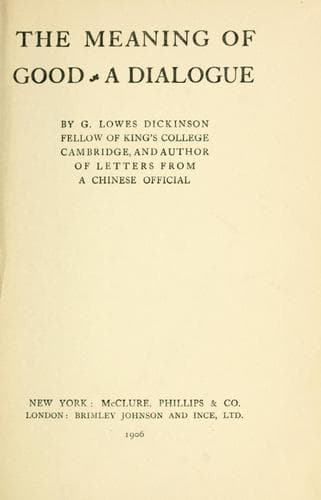
The Meaning of Good—A DialogueDickinson, G. Lowes (Goldsworthy Lowes)
Philosophy
The Meaning of Good—A Dialogue
Dickinson, G. Lowes (Goldsworthy Lowes)
Good and evil
"I have nothing more to say," he replied, "than I have said already."
"But I have!" cried Dennis, "and something very much to the point.
You see now the absurdities into which you are led by the position
you insisted on assuming, that Good involves conscious activity. If
it does, as you rightly inquired (though with a suicidal audacity),
conscious activity in whom? And to that question, of course, you can
find no answer."
"And yet," I said, endeavouring to turn the tables upon him, "I have
known you to maintain yourself that Good not merely involves, but is,
a conscious activity; only an activity in or of God."
"Rather," he replied, "that it _is_ God. But I don't really know
whether we ought to call God a conscious activity. Whatever He or It
be, is something that transcends our imagination. Only the things we
call good are somehow reflexes of God; and we have to accept them
as such without further inquiry. At any rate, we have no right to
endeavour, as you keep doing, to locate Good in some individual
persons."
"Well," I said, "here we come again to a fundamental difference
of view. All the Good of which I am aware as actually existing is
associated, somehow or other, with personal consciousness. I am
willing to admit, for the sake of argument, that the ultimate Good, if
ever we come to know it, might, perhaps, not be so associated. But of
that, as yet, I know nothing; you, perhaps, are more fortunate. And if
you can give us an account of Good, I mean, of course, of its content,
which shall represent it intelligibly to us as independent of any
consciousness like our own, I am quite ready to relinquish the
argument to you."
"I don't know," he replied, "that I can represent It to you in a way
that you would admit to be intelligible. I don't profess to have had
what you call 'experience' of it."
"Well, then," said Ellis, "what's the good of talking?"
"What, indeed!" I echoed, in some despondency. For I began to feel it
was impossible to carry on the conversation. But at this point, to my
great relief, Bartlett came to the rescue, not indeed with a solution
of the difficulty in which we were involved, but with a diversion of
which I was only too glad to take advantage.
"It seems to me," he said, "that you are getting off the track!
Whatever the ultimate Good may be, what we really want to know, is the
kind of thing we can conceive to be good for people like ourselves.
And I thought that was what you were going to discuss."
"So I was," I said, "if Dennis would have let me."
"I will let you, by all means," Dennis interposed, "so long as it is
quite understood that everything you say has nothing to do with the
real subject."
"Very well," said Bartlett, "that's understood. And now let's get
along, on the basis of you and me and the man in the street. What are
we trying to get, when we try to get Good? That I take it is the real
question."
Public-domain text, read in full here on John Shaqi.
Reviews
Reviews
No reviews yet
Be the first to share your thoughts on this work.
Elsewhere in the archive
Join the Discussion
Join the discussion
Sign in to leave a comment or review.
Sign InorCreate an account