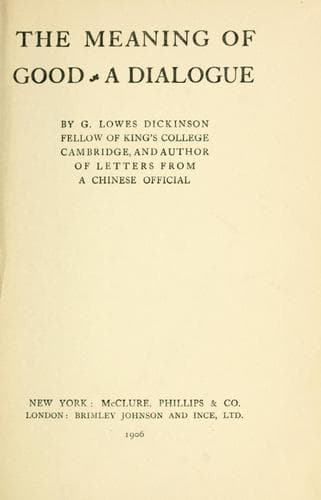
The Meaning of Good—A DialogueDickinson, G. Lowes (Goldsworthy Lowes)
Philosophy
The Meaning of Good—A Dialogue
Dickinson, G. Lowes (Goldsworthy Lowes)
Good and evil
Then they set off again In praise of the delights of such simple
sensations, and especially of those of the palate, instancing, I
remember, the famous tale about Keats--how he covered his tongue
and throat with cayenne pepper that he might enjoy, as he said, "the
delicious coolness of claret in all its glory." And when this had
gone on for some time, "Perhaps enough has been said," I began, "to
illustrate this particular kind of Good. We have, I think, recognized
to the full its merits; and we shall be equally ready, I suppose, to
recognize its defects."
"I don't know about that," said Ellis. "I, for my part, at any rate,
shall be very loth to dwell upon them. I sometimes think these are the
only pure Goods."
"But at least," I replied, "you will admit that they are precarious.
It is only at moments, and at moments that come and go without choice
of ours, that this harmonious relation becomes established between our
senses and the outer world. The very same things which at such times
appear to be perfectly at one with ourselves, as if they had been made
for us and we for them, we see and feel to have also a nature not only
distinct but even alien and hostile to our own. The water which cools
our skin and quenches our thirst also drowns; the fire which warms
and comforts also burns; and so on through all the chapter--I need not
weary you with details. Nature, you will agree, not only ministers to
our bodies, she torments and destroys them; she is our foe in ways at
least as varied and efficacious as she is our friend."
"But," objected Ellis, "that is only because we don't treat her
properly; we have to learn how to manage her."
"Perhaps," I replied, "though I should prefer to say, we have to learn
how to fight and subdue her. But in any case we have laid our finger
here upon a defect in this first kind of Goods--they are, as I said,
precarious. And the discovery of that fact, one might say, was the
sword of the angel that drove man out of his imaginary Eden. For
at first we may suppose him, (if Wilson will permit me to romance
a little,) seizing every delight as it offered itself, under an
instinctive impression that there were nothing but delights to be
met with, eating when he was hungry, drinking when he was thirsty,
sleeping when he was tired, and so on, in unquestioning trust of
his natural impulses. But then, as he learnt by experience how evil
follows good, and pleasure often enough is bought by pain, he would
begin, would he not, instead of simply accepting Good where it is, to
endeavour to create it where it is not, sacrificing often enough the
present to the future, and rejecting many immediate delights for the
sake of those more remote? And this involves a complete change in his
attitude; for he is endeavouring now to establish by his own effort
that harmony between himself and the world which he fondly hoped at
first was immediately given."
Public-domain text, read in full here on John Shaqi.
Reviews
Reviews
No reviews yet
Be the first to share your thoughts on this work.
Elsewhere in the archive
Join the Discussion
Join the discussion
Sign in to leave a comment or review.
Sign InorCreate an account