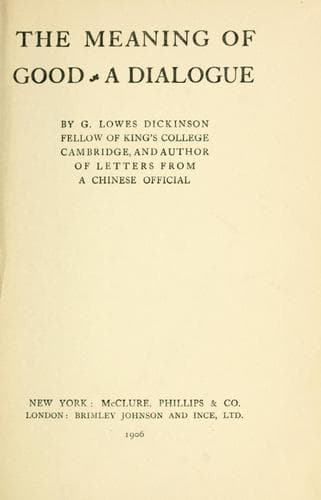
The Meaning of Good—A DialogueDickinson, G. Lowes (Goldsworthy Lowes)
Philosophy
The Meaning of Good—A Dialogue
Dickinson, G. Lowes (Goldsworthy Lowes)
Good and evil
"True," I said, "and yet I think that they too feel, or might be made
to fed if it were brought home to them, this same antagonism between
the nature of the stuff and the form that has been given to it.
The form will seem from this point of view something factitious and
artificial given to the stuff, not indeed by themselves, but by one
like themselves, and in their interest. They will contrast, perhaps,
as is often done, a picture of the landscape with the landscape
Itself. The picture, they will say, however beautiful, is not a
'natural' Good, not a real Good, not a Good in its own right; it is
a kind of makeshift produced by human effort, beautiful, if you will,
admirable, if you will, to be sought, to be cherished, to be loved in
default of a better, with the best faculties of brain and soul, but
still not that ultimate thing we wanted, that Good in and of itself,
as well as through and for us, Good by its own nature apart from our
interposition, self-moved, self-determined, self-dependent, and in
which alone our desires could finally rest.--Don't you think that some
such feeling may, perhaps, be at the bottom of Bartlett's criticism of
Art as unreal?"
Bartlett laughed. "If so," he said, "it is quite unknown to myself.
For to tell the truth, I have not understood a word that you have
said."
"Well," I said, "in that case, at any rate you can't disagree with me.
But what do the others think?" And I turned to Dennis and Leslie, for
Wilson and Parry did not seem to be attending. Leslie assented with
enthusiasm. But Dennis shook his head.
"I don't know," he said, "what to think about all that. It seems to me
rather irrelevant to the work of Art as such."
"Perhaps," I said, "but surely not to the work of Art as Good? Or do
you not agree with me that the true Good must be such purely of its
own nature?"
"Perhaps so," he replied; "it wants thinking over. But in any case I
agree with you so far, that I should never place the Good in Art."
"In what then?"
"I should be much more inclined to place it in Knowledge."
"In Knowledge!" I repeated. "That seems to me very strange!"
"But why strange?" he said. "Surely there is good authority for the
view. It was Aristotle's for example, and Spinoza's."
"I know," I replied, "and I used to think it was also mine. But of
late I have come to realize more clearly what Knowledge is; and now I
see, or seem to see, that whatever its value may be, it is something
that falls very far short of Good."
"Why," he said, "what is your idea of Knowledge?"
"You had better ask Wilson," I replied, "it is he who has instructed
me."
"Very well," he said, "I appeal to Wilson."
And Wilson, nothing loth, enunciated his definition of Knowledge.
"Knowledge," he said, "is the description and summing up in brief
formulæ of the routine of our perceptions."
"There!" I exclaimed. "No one, I suppose, would identify that with
Good?"
Public-domain text, read in full here on John Shaqi.
Reviews
Reviews
No reviews yet
Be the first to share your thoughts on this work.
Elsewhere in the archive
Join the Discussion
Join the discussion
Sign in to leave a comment or review.
Sign InorCreate an account