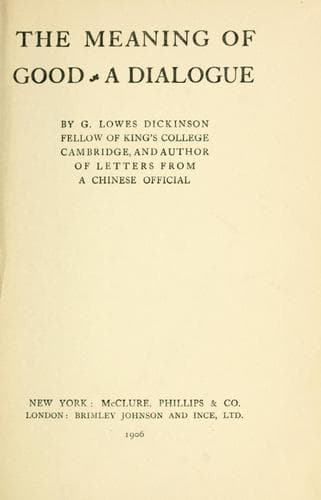
The Meaning of Good—A DialogueDickinson, G. Lowes (Goldsworthy Lowes)
Philosophy
The Meaning of Good—A Dialogue
Dickinson, G. Lowes (Goldsworthy Lowes)
Good and evil
"Well, but what _is_ the Good of it? That is what it is so hard for
a layman to get hold of. Does it consist in the discovery of Reality?
For that, I could understand, would be good."
"No," he said, "for we do not profess to touch Reality. We deal merely
with our perceptions."
"So that when, for example, you conceive such and such a perfect
fluid, or whatever you call it, and such and such motions in it, you
do not suppose this fluid to be real."
"No. It is merely a conception by means of which we are enabled to
give an account of the order in which certain of our perceptions
occur. But it is very satisfactory to be able to give such an
account."
"I suppose it must be," I said, "but once more, could you say more
precisely wherein the satisfaction consists? Is it, perhaps, in the
discovery of necessary connections?"
"No," he said, "we don't admit necessity. We admit only an order which
is, as a matter of fact, regular."
"You say, for example, that it so happens that all bodies do move
in relation to one another in the way summed up in the law of
gravitation; but that you see no reason why they should?"
"Yes."
"But ..." began Dennis, who had found difficulty all this time in
restraining himself.
"One moment!" I pleaded, "let Wilson have his say." And turning to him
I continued: "If, then, the satisfaction to be derived from scientific
activity does not consist in the discovery of Reality, nor yet in
that of necessary connection, wherein should you say, does it consist?
Perhaps in the regulating of expectation?"
"What do you mean by that?"
"I mean, that it is painful for us to live in a world in which
we don't know what to expect; it excites not only our fears and
apprehensions, but also a kind of intellectual disgust. And,
conversely, it is a relief and a pleasure to discover an order among
our experiences, not only because it enables us the better to utilize
them for our ends (for that belongs to the practical results of
science), but because in itself we prefer order to disorder, even if
no other advantage were to be got out of it."
"I don't know that we do!" objected Ellis, "it depends on the kind
of order. An order of dull routine is far more intolerable than a
disorder of splendid possibilities! Ask the Oriental why he objects to
British rule! Simply because it is regular! He prefers the chances
of rapine, violent and picturesque, to the dreary machine-like
depredations of the tax-collector."
"Yes," I said, "but there you take in a number of complex factors. I
was thinking merely of the Good to be got out of scientific activity
as such. And I think there is an intellectual satisfaction in the
discovery of order, even though it be dissociated from necessity."
Public-domain text, read in full here on John Shaqi.
Reviews
Reviews
No reviews yet
Be the first to share your thoughts on this work.
Elsewhere in the archive
Join the Discussion
Join the discussion
Sign in to leave a comment or review.
Sign InorCreate an account