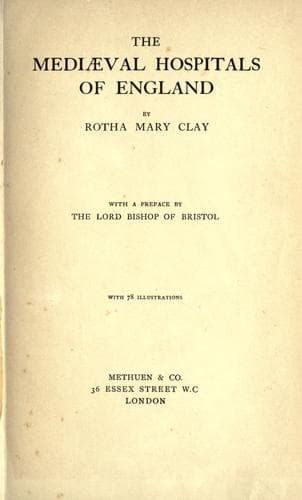
Charities -- Great Britain; Hospitals -- Great Britain; Hospitals, Medieval; Leprosy -- England
(c) _Finance._—The Lateran Council of 1179 decreed that
leper-communities should not pay tithe from gardens and orchards, nor
of the increase of cattle, and this was ratified in the Provincial
Council of Westminster in 1200. The [p196] Church wished to go a
step further and ordain that neither lazar-house, Domus Dei nor poor
hospital should pay taxes, which was set forth by Gregory X; entries
upon Papal Registers in 1278 declare that certain English houses,
including Ospringe, should share this immunity. But the decree was
not necessarily accepted in England, remission of taxation being a
royal prerogative; Ospringe was a Crown hospital to which exemption
was renewed from time to time of the king’s grace. In the cases of
lazar-houses, a curious distinction was made, witnessing incidentally
to national independence—“And let not the goods of lepers be taxed
where they are governed by a leper” (_par Sovereyn meseal_). This
rule occurs in the First Statute of Westminster (3 Edw. I),[118] and
afterwards in rolls and writs dated 1297, 1307, etc.[119] It was
evidently in allusion to this custom that, in remitting a wool-tax, it
is stated that St. Bartholomew’s, Rochester, was governed by a leprous
prior (1342), but a few years later the king granted it freedom from
taxation for ever. Many houses were freed by charter from local and
general contributions and tolls.
Land-tenure may be included under finance. Before the enactment of
the Statute _De Religiosis_, benefactors met with no hindrance in
promoting any plan for endowment, but after 1279 permission was sought
“to alienate land in mortmain.” On payment of a small fine, communities
were empowered to accept property to a certain value. This developed
into the “licence to found” named in fourteenth-century rolls, and
subsequently into incorporation. [p197]
(ii) RELATIONS WITH THE PARISH PRIEST
Before the foundation of a hospital chapel, special permission
was required from the bishop, with a guarantee that it should not
interfere with the parochial system. It was necessary clearly to
define privileges, lest friction should arise. Grants in civil and
ecclesiastical registers include “a chapel, bell and chaplain,”
oblations, sepulture and “the cure of souls.”
Public-domain text, read in full here on John Shaqi.
Reviews
Reviews
No reviews yet
Be the first to share your thoughts on this work.
Elsewhere in the archive
Join the Discussion
Join the discussion
Sign in to leave a comment or review.
Sign InorCreate an account